tiktok
automation
tutorial
How to Automate TikTok Posting with OpenClaw

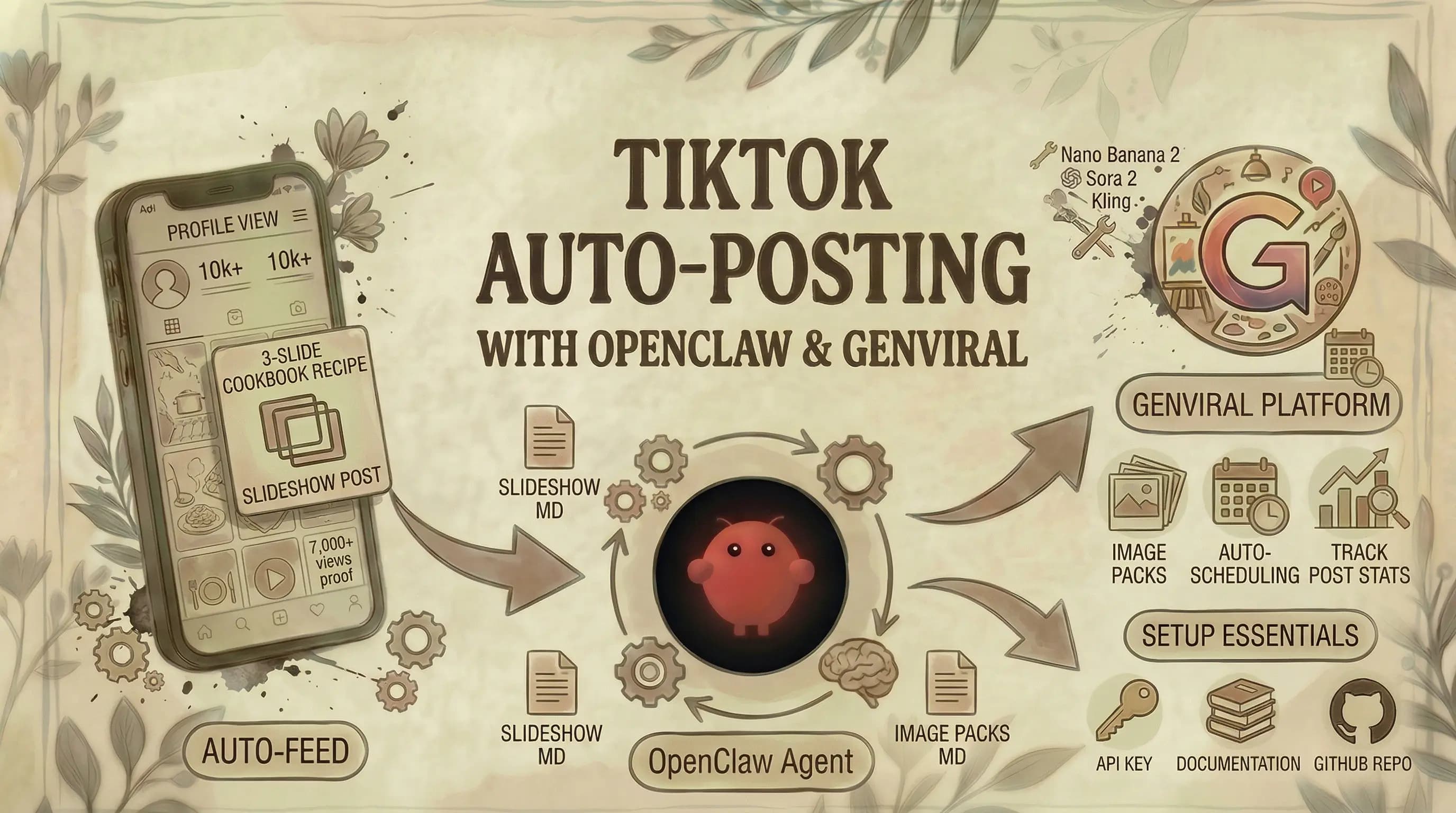
- We use OpenClaw agents to automatically generate and post TikTok slideshows (like three-page cookbook recipes) on a recurring schedule with zero manual work.
- Setup requires three things: the Genviral Skill GitHub repo, the API documentation, and an API key.
- Split your skill MD files by endpoint category (posts, slideshows, studio AI, etc.) so your agent only loads what it needs per run. This saves a lot of tokens.
- Set up image packs and reference images in Genviral before automating. The AI uses these to keep your visual style consistent across posts.
- Only automate content formats you've already validated manually. The AI is great at scaling proven formats, not discovering new ones.
Proof It Works
Before we get into setup, here's what this looks like in practice. One of the accounts we run is a cooking page that publishes automated three-page cookbook recipes: an introduction slide, an ingredients list, and the cooking instructions. All generated and posted by an OpenClaw agent connected to Genviral.
This post alone has over 7,000 views, and the entire account runs without any manual intervention. The same approach works for videos too, not just slideshows.
What You Need
Three things to feed your OpenClaw agent:
- The GitHub repo - github.com/fdarkaou/genviral-skill (also linked in the Genviral homepage footer)
- The API documentation - docs.genviral.io
- An API key - generate one at genviral.io/api-keys (requires an active subscription)
You can feed all three to your agent in a single message. It works with any chatbot that supports OpenClaw: Telegram, WhatsApp, or whatever you prefer. The mechanics are the same.
Step 1: Organize Your Skill Files
This is the single biggest token saver. When you set up the Genviral skill, create separate MD files for each endpoint category:
genviral-skill/
├── files/
├── folders/
├── studio-ai/
├── posts/
├── slideshows/
├── packs/
├── templates/
└── analytics/
Why does this matter? If your TikTok agent only posts slideshows, it doesn't need the templates endpoint or the analytics endpoint loaded on every run. By splitting things up, you avoid loading the entire API docs each time, which saves a lot of tokens and by extension a lot of money.
In your skill MD file, reference only the specific endpoint files that your automation actually needs. For a TikTok slideshow agent, that's typically Slideshows, Studio AI (for image generation), Packs (for image packs), and Posts.
Step 2: Set Up Your Image Packs and Reference Images
This step is critical and often overlooked. Before your agent can create slideshows, it needs visual assets to work with.
In the Genviral dashboard:
- Go to Media Library and then Image Packs
- Create your packs and name them descriptively. The AI reads pack names and folder names to understand what the images are about
- Upload reference images that represent your desired visual style
Genviral uses AI in the background to analyze and enrich the metadata of your images. But good naming on your end makes a huge difference. For example, instead of "Pack 1", use "Cookbook Recipe Cards - Warm Tones" so the agent knows exactly what it's working with.
If you're generating images rather than using pre-made ones (like we do with Nano Banana 2), your reference images serve as style guides. The AI uses them to keep a consistent look across all generated content.
Step 3: Connect Your TikTok Account in Genviral
Before your agent can post anything, connect your TikTok account in the Genviral dashboard.
- Go to the Social Posts section
- Click Manage Accounts
- Click Connect and add your TikTok account
- Create a test post manually to verify the connection works
Step 4: Walk Through the Setup Step by Step
This is where having a conversation with your agent pays off. Instead of trying to configure everything in one prompt, tell your agent:
"I want to post TikTok slideshows automatically. Please walk me through the setup step by step and ask me to specify each part of the configuration."
The agent will then ask you about:
- Account selection - which TikTok account to post to
- Content type - slideshows, videos, or both
- Image generation - use image packs, generate with AI Studio, or bring your own
- Image style - which reference images or prompts to use
- Slideshow format - how many slides, what structure (intro + ingredients + instructions, etc.)
- Caption format - tone, length, hashtags
- Posting mode - publish directly or upload as draft for your review
- Schedule - how often, what times
Answer each question, and the agent configures itself accordingly.
Step 5: Choose Your Content Pipeline
Depending on what you want to post, there are a few different paths:
Slideshows (what we use)
Use the Slideshows endpoint to create multi-slide posts. This is what we use for the cookbook recipes. The agent generates images, assembles them into a slideshow, writes a caption, and posts to TikTok.
Videos
If you already have videos (maybe your OpenClaw agent is connected to Google Drive, Canva, or another source), use the file upload function and the Posts endpoint to publish them directly.
AI-Generated Images and Videos
Use the Studio endpoint to generate content with AI models. Available models include Nano Banana 2, Kling, Sora 2, and all other leading models listed in the API docs.
Step 6: Validate Before You Automate
Before flipping the switch, have the agent create at least one sample post in chat so you can review it.
Check:
- Is the image quality acceptable?
- Does the slideshow flow make sense?
- Is the caption well-written?
- Are there any visual artifacts? (If so, add negative prompts to prevent them in future generations)
If something looks off, tell the agent what to fix. Once you're satisfied, test the full end-to-end flow by publishing one real post through the agent. You can use draft mode for this if you want to review it on TikTok before it goes live.
Step 7: Set Up the Cron Job
Once everything checks out, tell the agent to set up a cron job. The agent will:
- Generate images using the Studio endpoint (or pull from image packs)
- Assemble them into a slideshow
- Write a caption with relevant hashtags
- Publish to TikTok via the Posts endpoint
- Repeat on your chosen schedule
Every automated post shows up in your Genviral dashboard calendar tagged with source: partner_api, so you always have a full audit trail.
Bonus: Connect Analytics for Recursive Improvement
One of the more powerful things you can do is connect your analytics within Genviral (under the Analytics tab). Once connected, your agent has access to performance data and can:
- Analyze which posts are performing well
- Look at what captions, formats, and styles drive the most views
- Recursively improve future content based on what the data shows
This turns your automation from "set it and forget it" into something that actually gets better over time.
Tips From Our Setup
A few things we've learned running this:
- Only automate proven formats. If you already have a content template that works (like our three-page cookbook recipes), the AI is excellent at scaling it. But if you're still figuring out what format resonates with your audience, do that manually first. The AI is not as good at discovering new formats as it is at replicating and scaling existing ones.
- Split your skill files. This keeps coming up because it matters that much. Don't load the entire API docs every run.
- Name everything descriptively. Image packs, folders, reference images. The better the naming, the better the AI understands what to pick and how to use it.
- Use step-by-step confirmation. Have the agent ask you about each part of the setup individually. Don't try to configure everything in one prompt.
- Draft mode is your friend. When starting out, have the agent upload as drafts so you can review on TikTok before anything goes live.
- Review weekly. Even fully automated, check in once a week. Skim the dashboard, spot-check a few posts, and adjust if needed.
Getting Started
Full disclosure: I'm one of the founders of Genviral, so I'm biased. But we built this because we needed it ourselves, and the cookbook recipe account is one of many we run this way.
To get started:
- Sign up at genviral.io
- Set up your image packs and reference images in the Media Library
- Connect your TikTok account under Social Posts
- Generate an API key at genviral.io/api-keys
- Install the Genviral Skill in OpenClaw
- Feed it the API docs
- Walk through the setup step by step
- Validate, then automate
The Genviral API and OpenClaw Skill are available on all paid plans, starting at $29/month on the Creator tier.
If you need help setting things up, you can book a call with me via our landing page. It's completely free for subscribers. We also have a Knowledge Base with video tutorials covering slideshows, image packs, templates, automations, and more.
If you have any questions, drop them in the comments on the video or reach out through our support chat or Discord community.
Related Guides
- How to Use OpenClaw to Automate Your Social Media (Full Guide)
- How to Automate TikTok Posting with Hermes Agent
- 15 Best OpenClaw Skills for Social Media Marketing
- How to Automate LinkedIn Posting with OpenClaw and Genviral
- How to Automate Facebook Posting with OpenClaw and Genviral
- How to Automate Pinterest Posting with OpenClaw and Genviral
- How to Automate Instagram Posting with OpenClaw and Genviral
- How to Automate YouTube Posting with OpenClaw and Genviral
- How to Delete Your TikTok Account
Viktor
Occasional writer, sometimes even funny. Also loves to start conmpanies (weird, I know).