automation
tutorial
How to Automate Facebook Posting with OpenClaw

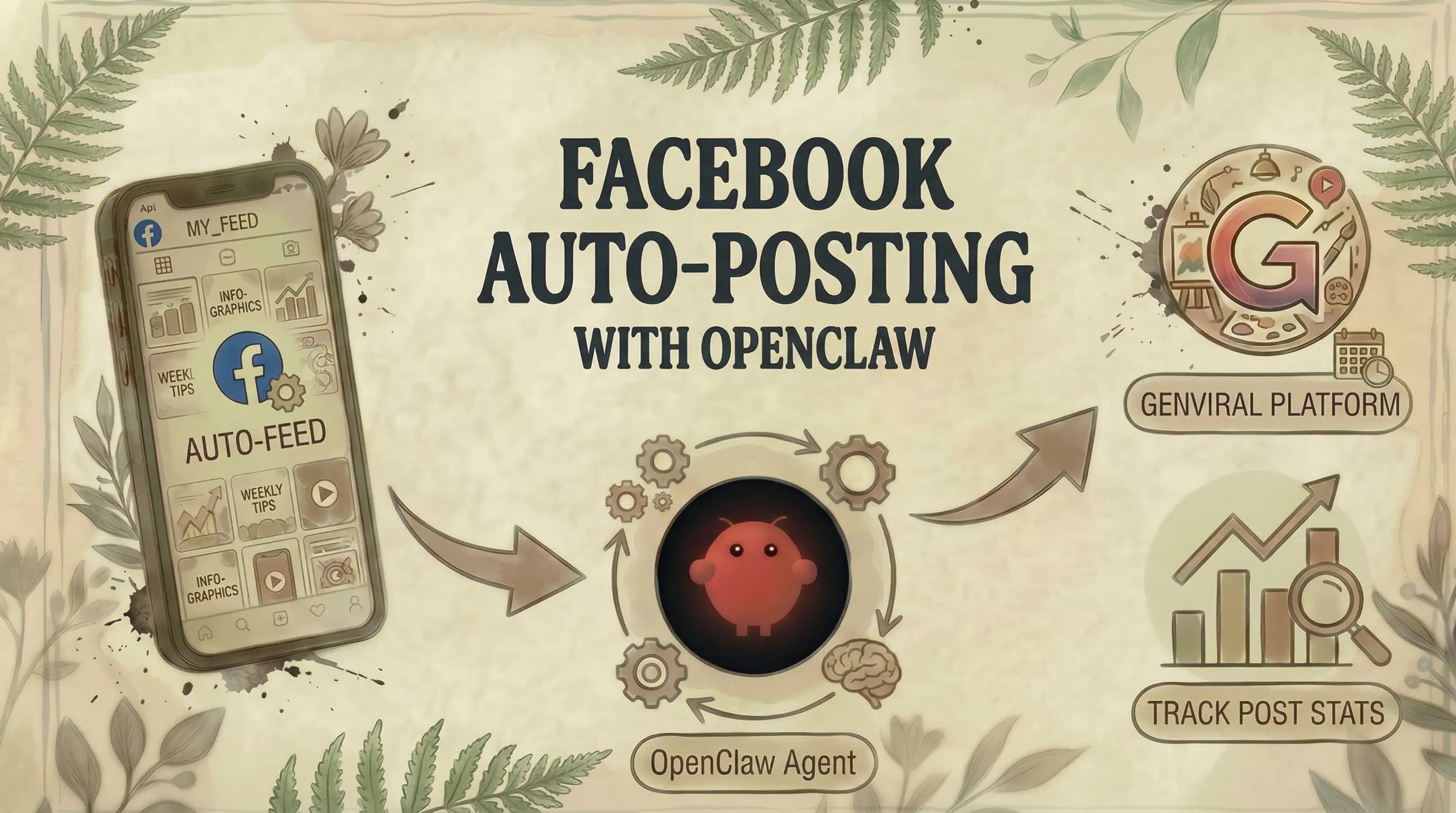
- We use OpenClaw agents to automatically post infographics to Facebook on a recurring schedule - the goal is to have an active page before running ads, which improves trust and conversions.
- Setup requires three things: the Genviral Skill GitHub repo, the API documentation, and an API key.
- Split your skill MD files by endpoint category (posts, studio AI, etc.) so your agent only loads what it needs per run - this saves a lot of tokens.
- The same mechanics also work for posting Reels and videos to Facebook, not just images.
- Connect your Facebook account in Genviral first, then walk through the setup step by step with your agent.
Why We Automate Facebook
The idea is straightforward. When you run paid ads on Facebook, people click through to your page. If the page looks empty or inactive, trust drops and so do conversions. So we use OpenClaw to post infographics with captions to our Genviral Facebook page on a near-daily basis - that way the page looks actively maintained when someone lands on it from an ad.
Here's one of the posts our agent generated and published automatically:
This is mostly filler content - infographics about social media tips, automation workflows, and content strategy. The point isn't to go viral with these posts. The point is that when someone sees an ad, clicks to our Facebook page, and sees consistent content, they're more likely to trust us and convert.
The same approach works for Reels and videos too, not just image posts.
If you prefer to work inside Claude, the companion Claude Facebook automation guide covers the MCP connector and the path from one reviewed video post to a recurring Claude Cowork task.
What You Need
Three things to feed your OpenClaw agent:
- The GitHub repo - github.com/fdarkaou/genviral-skill (also linked in the Genviral homepage footer)
- The API documentation - docs.genviral.io
- An API key - generate one at genviral.io/api-keys (requires an active subscription)
You can feed all three to your agent in a single message. It works with any chatbot that supports OpenClaw: Telegram, WhatsApp, or whatever you prefer.
Step 1: Organize Your Skill Files
This is the single biggest token saver. When you set up the Genviral skill, create separate MD files for each endpoint category:
genviral-skill/
├── files/
├── folders/
├── studio-ai/
├── posts/
├── slideshows/
├── packs/
├── templates/
└── analytics/
Why does this matter? If your Facebook agent only posts images with captions, it doesn't need the slideshows endpoint, the templates endpoint, or the analytics endpoint loaded on every run. By splitting things up, you avoid loading the entire API docs each time - which saves a lot of tokens and by extension a lot of money.
For a Facebook image posting agent, you'll typically need Posts, Studio AI (for image generation), and maybe Packs (if using image packs). That's it.
Step 2: Connect Your Facebook Account in Genviral
Before your agent can post anything, you need to connect your Facebook account in the Genviral dashboard.
- Go to the Social Posts section
- Click Manage Accounts
- Click Connect and add your Facebook account (and Instagram if you want to post to both simultaneously)
- Create a test post manually to verify the connection works
This initial account connection has to happen in Genviral. Once connected, your OpenClaw agent can reference the account by ID when creating posts through the API.
Step 3: Let Your Agent Familiarize Itself
If you already have other automations running (like we had Pinterest and TikTok), tell your agent to familiarize itself with your existing setup first. This way it understands your content style, posting patterns, and how things are structured before building the Facebook flow.
If this is your first automation, just feed the agent the skill files, the API docs, and your API key, then tell it to set up the Genviral skill and configure the Facebook automation.
Step 4: Walk Through the Setup Step by Step
This is a general best practice with AI agents, but especially important here. Instead of trying to configure everything in one prompt, tell your agent:
"I want to post to Facebook automatically. Please ask me step-by-step questions about each part of the setup."
The agent will then ask you about:
- Account selection - which Facebook account (and optionally Instagram) to post to
- Content type - images, videos, or both
- Image style - what visual direction, which AI model to use (e.g., Nano Banana 2, GPT Image 1.5)
- Aspect ratio - square, landscape, or portrait depending on your content type
- Caption format - tone, length, hashtags, call-to-action
- Scheduling - how often, what times (we post every second day)
- Approval flow - publish directly or review each post first
Answer each question, and the agent configures itself accordingly.
Step 5: Review a Sample Post
Before going autonomous, have the agent create at least one sample post in chat so you can review it.
Check:
- Is the image quality acceptable?
- Does the caption match your brand voice?
- Are the hashtags relevant?
- Are there any visual artifacts? (If so, add negative prompts to prevent them in future generations)
If something looks off, tell the agent what to fix. Once you're satisfied, test the full end-to-end flow by publishing one real post through the agent.
Step 6: Test the End-to-End Flow
Before setting up the cron job, publish one post through the agent to test the full pipeline:
- Agent generates the image via the Studio endpoint
- Agent creates the post with caption, hashtags, and scheduling
- Post is published to Facebook via the Posts endpoint
- Post appears in your Genviral dashboard calendar tagged with
source: partner_api
If the post goes through successfully and looks good on Facebook, you're ready to automate.
Step 7: Set Up the Cron Job
Once everything checks out, configure your agent to run on a schedule. For our setup, we post every second day - a new infographic is generated and published automatically without any intervention.
The agent will:
- Generate a new image using the Studio endpoint
- Write a caption with relevant hashtags
- Publish to Facebook (and optionally Instagram) via the Posts endpoint
- Repeat on your chosen schedule
Every automated post shows up in your Genviral dashboard calendar, so you always have a full audit trail of what was posted and when.
Posting to Facebook and Instagram Together
Since we also run an Instagram automation with the same goal (pre-filling the page before running ads), we often post the same infographic to both platforms in a single API call. The Genviral API supports multi-account posting - just include both the Facebook and Instagram account IDs in the same request.
This is especially efficient because you generate the image once and distribute it to both platforms. The captions and hashtags can differ per platform if needed, but for filler content like ours, we keep them the same.
Tips From Our Setup
A few things we've learned running this:
- Do it manually first. Before automating, use the Genviral dashboard to create and post content manually. Familiarize yourself with the functionality - the API is a programmatic extension of what the product can do, so if you know how to use the product, you'll be much more capable with the API.
- Split your skill files. This keeps coming up because it matters that much. Don't load the entire API docs every run. Only give the agent the endpoints it actually needs.
- Use step-by-step confirmation. Have the agent ask you about each part of the setup individually. Don't try to configure everything in one prompt.
- Filler content vs. viral content. If you're using this to pre-fill your page (like we do), the bar for quality is "looks professional and on-brand." If you're trying to go viral, you really want to understand the intricacies of what works on Facebook and validate formats manually before automating.
- Review weekly. Even fully automated, check in once a week. Skim the dashboard, spot-check a few posts, and adjust if needed.
Getting Started
Full disclosure - I'm one of the founders of Genviral, so I'm biased. But we built this because we needed it ourselves, and the approach of pre-filling brand pages before running ads has worked well for us across both Facebook and Instagram.
To get started:
- Sign up at genviral.io
- Connect your Facebook account under Social Posts
- Generate an API key at genviral.io/api-keys
- Install the Genviral Skill in OpenClaw
- Feed it the API docs
- Walk through the setup step by step
- Validate, then automate
The Genviral API and OpenClaw Skill are available on all paid plans, starting at $29/month on the Creator tier.
If you have any questions, drop them in the comments on the video or reach out through our support chat or Discord community. We're also happy to hop on a call to help set this up - that offer stands for every Genviral customer.
Related Guides
- Claude Facebook Automation with Claude Cowork
- How to Automate Facebook Posting with Hermes Agent
- How to Use OpenClaw to Automate Your Social Media (Full Guide)
- 15 Best OpenClaw Skills for Social Media Marketing
- How to Automate LinkedIn Posting with OpenClaw and Genviral
- How to Automate Instagram Posting with OpenClaw and Genviral
- How to Automate Pinterest Posting with OpenClaw and Genviral
- How to Automate TikTok Posting with OpenClaw and Genviral
- How to Automate YouTube Posting with OpenClaw and Genviral

Viktor
Occasional writer, sometimes even funny. Also loves to start conmpanies (weird, I know).