social-media
api
automation
10 Best Social Media APIs for Posting & Automation

- Unified social media APIs let you post, schedule, and pull analytics across every major platform through a single integration - eliminating the need to maintain six or more platform-specific SDKs, OAuth flows, and approval processes.
- We tested 10 APIs across five criteria: platform coverage, posting capabilities, analytics depth, developer experience, and pricing transparency.
- Genviral is the only API that covers the full pipeline - AI image/video/slideshow generation, cross-platform scheduling, analytics (TikTok, Instagram, YouTube), TikTok trend briefs, and video Bulk Creation - from one REST API plus a 47-command OpenClaw skill.
- Pricing ranges from free tiers (Upload-Post, SociaVault, Buffer) to usage-based models ($0.01/post on Outstand) to entry-level paid plans (Genviral from $29/mo with API access included) up to enterprise ($199+/seat/month for Hootsuite, $333/month for Socialinsider Advanced).
- If you are building AI agents, creator tooling, or a SaaS product that needs to create AND distribute content, Genviral is the only option on this list that covers the full workflow natively.
If you have ever tried to integrate with TikTok, Instagram, and LinkedIn all at once, you already know the pain. Every platform has its own OAuth flow, its own rate limits, its own content format requirements, and its own developer-program approval process that can drag on for weeks or months. Facebook and Instagram require a video screencast demo to pass app review. TikTok uploads are async and require webhook callbacks and domain verification. LinkedIn's docs still mix v1 and v2 endpoints with confusing scope approval. X/Twitter moved to paid tiers that can reach $42,000/month. Building and maintaining direct integrations across six or more platforms is a full-time engineering job.
That is why unified social media APIs exist. Instead of juggling half a dozen platform-specific integrations and dealing with ongoing breakage every time a platform updates its authentication flow or deprecates an endpoint, you use one API to post, schedule, and pull analytics across every major social network.
In this guide, we tested and compared 10 of the best social media APIs available in 2026 - from all-in-one content creation platforms with built-in APIs, to developer-focused posting middleware, to pure analytics APIs that only read data. Whether you are building a SaaS product, running an agency, automating content with AI agents, or feeding social data into an analytics dashboard, there is an API on this list that fits.
What Is a Social Media API?
A social media API is a programmatic interface that lets your application interact with social media platforms without a human logging into a dashboard. With an API, your code can:
- Publish posts (text, images, videos, carousels, slideshows, reels, stories).
- Schedule content for future publish times across timezones.
- Retrieve engagement metrics (views, likes, comments, shares, saves, follower growth).
- Manage connected accounts (OAuth tokens, refresh cycles, permissions).
- Listen for webhooks (new comments, post status changes, mention alerts).
- Create, update, and delete content programmatically.
There are two broad categories of social media APIs:
- Native platform APIs - direct integrations with Facebook Graph, TikTok Developers, LinkedIn API, YouTube Data API, Instagram Graph, Pinterest API, and X/Twitter API. These are free or platform-priced, but each has its own auth, schema, and approval process.
- Unified / aggregator APIs - third-party services that wrap all native APIs behind a single consistent interface. You integrate once and the provider handles OAuth flows, schema normalization, rate limiting, and platform-specific quirks.
The 10 APIs below are all unified or aggregator APIs. We also include a reality-check table at the bottom for teams considering going direct to platform.
How We Evaluated
We assessed each API across five criteria:
- Platform coverage - How many networks are supported, and which ones? Does the API cover mainstream (TikTok, Instagram, YouTube, Facebook, LinkedIn, X) plus emerging networks (Bluesky, Threads, Mastodon, Reddit, Telegram, Discord)?
- Posting capabilities - Can you schedule, publish immediately, post videos, images, carousels, slideshows, stories, and reels? Can you handle multi-media uploads, auto-format adaptation, and draft management?
- Analytics - Does the API return engagement metrics, post-level data, account-level insights, competitor data, and historical snapshots? How deep is the data?
- Developer experience - Quality of docs, SDKs for popular languages, consistency of response envelopes, idempotency, webhook reliability, and OAuth handling.
- Pricing transparency - Is pricing predictable? Does the cost scale reasonably for indie developers, startups, agencies, and enterprises?
We also gave credit for unique capabilities: AI content generation, trend intelligence, workspace isolation for agencies, native AI-agent compatibility (MCP, OpenClaw skills), and multi-region hosting.
Quick Comparison
| API | Platforms | Best For | Posting | Analytics | AI Content | Starting Price |
|---|---|---|---|---|---|---|
| Genviral | 6 | All-in-one: create + post + analyze | Yes | Yes (3 platforms) | Yes | $29/mo |
| Ayrshare | 13+ | Platform breadth | Yes | Yes | Basic | $24.99/mo |
| Outstand | 10+ | Usage-based pricing | Yes | Yes | No | $5/mo + $0.01/post |
| Upload-Post | 11 | Budget-friendly posting | Yes | Yes | No | $16/mo |
| PostForMe | 9 | Quick SaaS integration | Yes | Yes | No | $10/mo |
| Buffer API | 8 | Established scheduling | Yes | Yes | No | $5/mo per channel |
| Hootsuite API | 7 | Enterprise management | Yes | Yes | No | $199/seat/mo |
| Socialinsider | 6 | Deep analytics data | No | Yes | No | $333/mo (API tier) |
| Data365 | 6 | Data collection & normalization | No | Yes | No | Custom |
| SociaVault | 25+ | Free data extraction | No | Yes | No | 50 free credits |
1. Genviral - Best All-in-One Social Media API
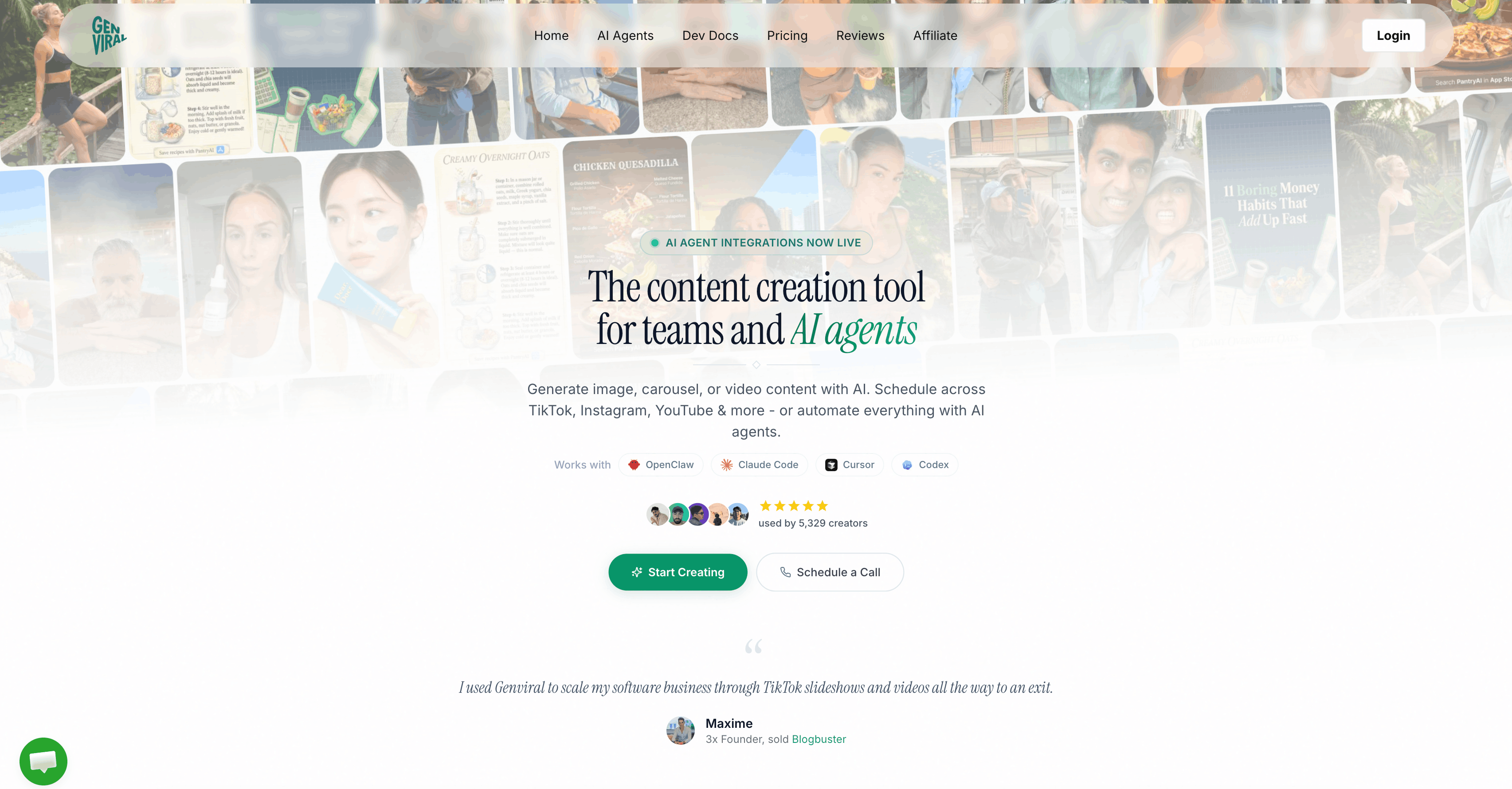
Platforms: TikTok, Instagram, YouTube, Facebook, Pinterest, LinkedIn (posting to all 6; analytics on TikTok, Instagram, and YouTube)
Genviral positions itself as "the content creation tool for teams and AI agents." It is a dual-mode platform: on one side, a creator-facing app for generating and scheduling content; on the other, a REST API plus OpenClaw skill that lets AI agents run the full loop autonomously. Where every other API on this list does one or two parts of the job, Genviral covers trend research, AI content generation, cross-platform publishing, and analytics through a single integration.
Key Features
- Cross-platform posting - Publish or schedule to all 6 platforms with one
POST /postscall. Supports videos, photo carousels, and slideshows. TikTok photo carousels go up to the platform max of 35 images. - AI content generation - Generate images with Nano Banana (and Pro variants), SeeDream 5, GPT Image 1.5, Higgsfield Soul, Imagen 4, and Phota. Generate videos with Sora 2 (and Sora 2 Pro), Veo 3.1 (and Veo 3.1 Fast), Kling 2.6 Pro (I2V / T2V / Motion), WAN 2.5 / 2.6, Fabric, and Creatify Lipsync. Image generation is synchronous; video generation is async with status polling.
- TikTok trend briefs -
GET /trends/briefreturns top hashtags, top sounds, top creators, UTC posting windows, hook angles, and sample videos with engagement metrics for any keyword. Cached 3 hours. - Analytics - Track any TikTok, Instagram, or YouTube handle (yours or competitors). Snapshots include follower counts, engagement rates, views, likes, and post-level metrics. Facebook, Pinterest, and LinkedIn analytics are not yet in the API.
- Bulk Creation - Create video Bulk Creation pipelines of 5-200 items per campaign programmatically. The API generates the content; posting is a separate call per account (so you control fan-out).
- Slideshows, templates, image packs - All CRUD endpoints exposed. Reusable templates and image collections keep branding consistent across AI-generated content.
- Workspace vs personal keys - Each API key is scoped as either workspace or personal (mutually exclusive). Cross-scope access returns 404 - useful for agencies managing multiple clients safely.
- Response envelope + idempotency - Every endpoint returns
{ ok, code, message, data }(pluserror_codeon failures).POST /postsaccepts anexternal_idfor safe retries; duplicate IDs return the original post withduplicate=true. - Platform-specific settings -
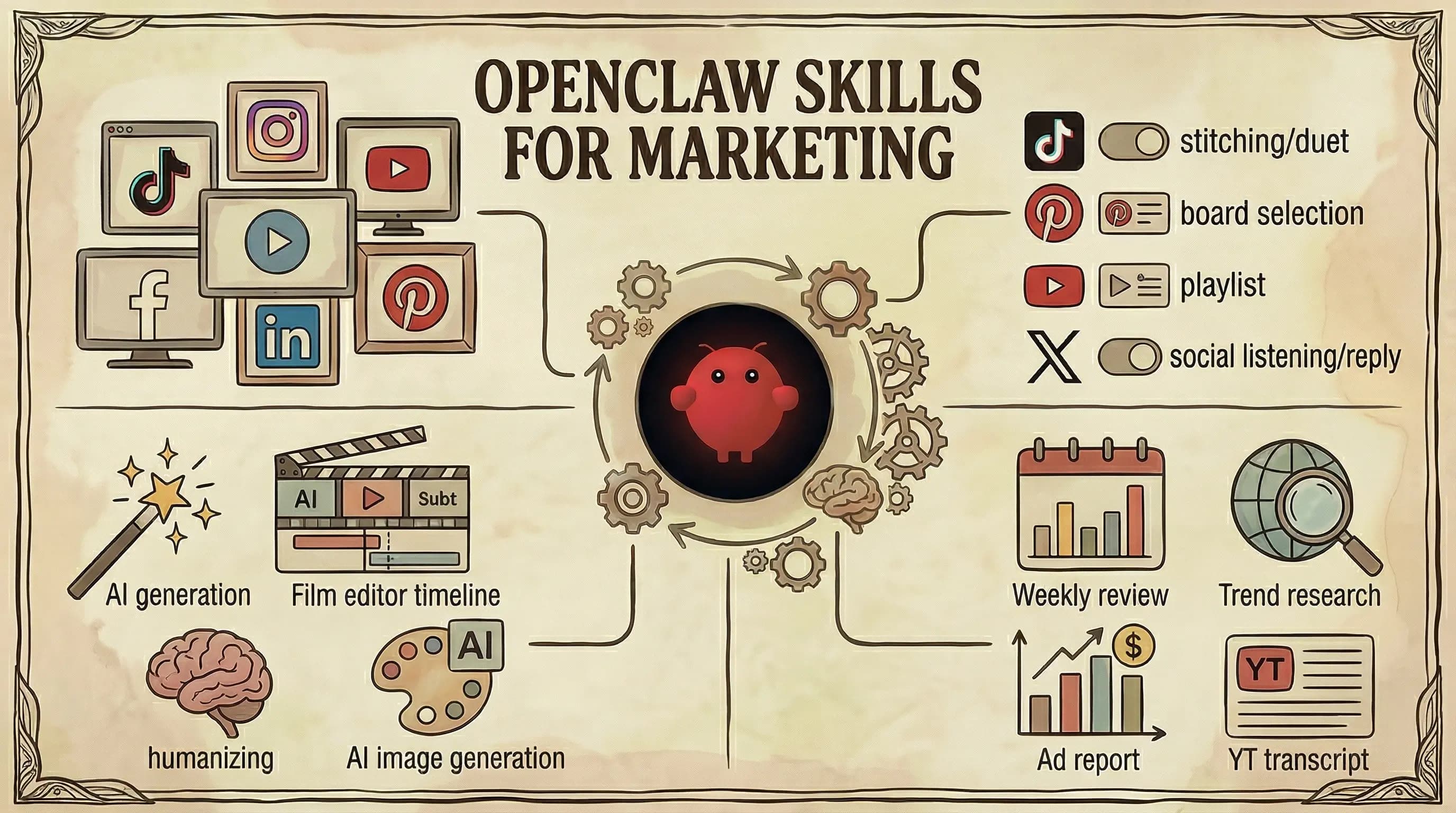
tiktok(privacy, commercial-content flags, comment/duet/stitch toggles, MEDIA_UPLOAD for slideshows) andpinterest(board_id, title, link, up to 30 tags) settings objects are supported. Other platforms use shared defaults. - OpenClaw skill - Ships an official OpenClaw social media skill with 47 commands across Trend Spotting, AI Studio, Accounts, Slideshows, Posts, Image Packs, Templates, and Analytics. Works with Claude Code, Cursor, Codex, and any client that speaks the skill protocol.
- Dedicated hosted accounts (optional add-on) - If your use case can't use BYO OAuth accounts, Genviral offers dedicated US-based mobile devices for posting, billed per account.
Pricing
| Plan | Price (Monthly) | Credits | Social Accounts | API Access |
|---|---|---|---|---|
| Creator | $29/mo ($290/yr) | 200/mo | 10 | Yes |
| Professional | $49/mo ($490/yr) | 500/mo | 15 | Yes |
| Business | $99/mo ($990/yr) | 1,200/mo | 30 | Yes + workspaces |
- Credit top-ups - $10 for 50 credits, $30 for 250, $45 for 500. Credits roll over.
- Hosted accounts (optional) - $90/month per account, minimum 5 accounts. 6-month prepay drops this to $75/account.
- 30-day money-back guarantee across all plans.
- Legacy note - The old $9/month Scheduler plan is no longer purchasable. Only grandfathered legacy customers still remain on that tier.
Credits cover AI generation and Bulk Creation runs. For example, image generation costs 1-3 credits depending on model, video generation 5-72 credits, and a Bulk Creation campaign starts at 50 credits plus per-item AI/render costs.
Pros
- Only API on this list with native AI image + video + slideshow generation alongside posting.
- TikTok trend briefs are a rare and useful endpoint.
- Workspace-scoped API keys with strict isolation - good for agency multi-tenancy.
- 47-command OpenClaw skill makes it the most AI-agent-native option in 2026.
- Handles TikTok photo carousels (up to 35 images), which most APIs skip.
Cons
- 6 platforms only - no Threads, Bluesky, X/Twitter, or Reddit.
- Analytics API covers only TikTok, Instagram, and YouTube today.
- Platform-specific settings are exposed only for TikTok and Pinterest; the other four use shared defaults.
- Idempotency keys are supported on
POST /postsspecifically, not every endpoint. - Credit-based pricing is a mental-model shift if you're used to flat per-post pricing.
Best For
Developers and AI agents that need to create and distribute content from one API - not just post someone else's. Best for creator tools, AI-agent workflows, and agencies running high-volume slideshow / short-form pipelines with workspace isolation.
2. Ayrshare - Best for Platform Breadth
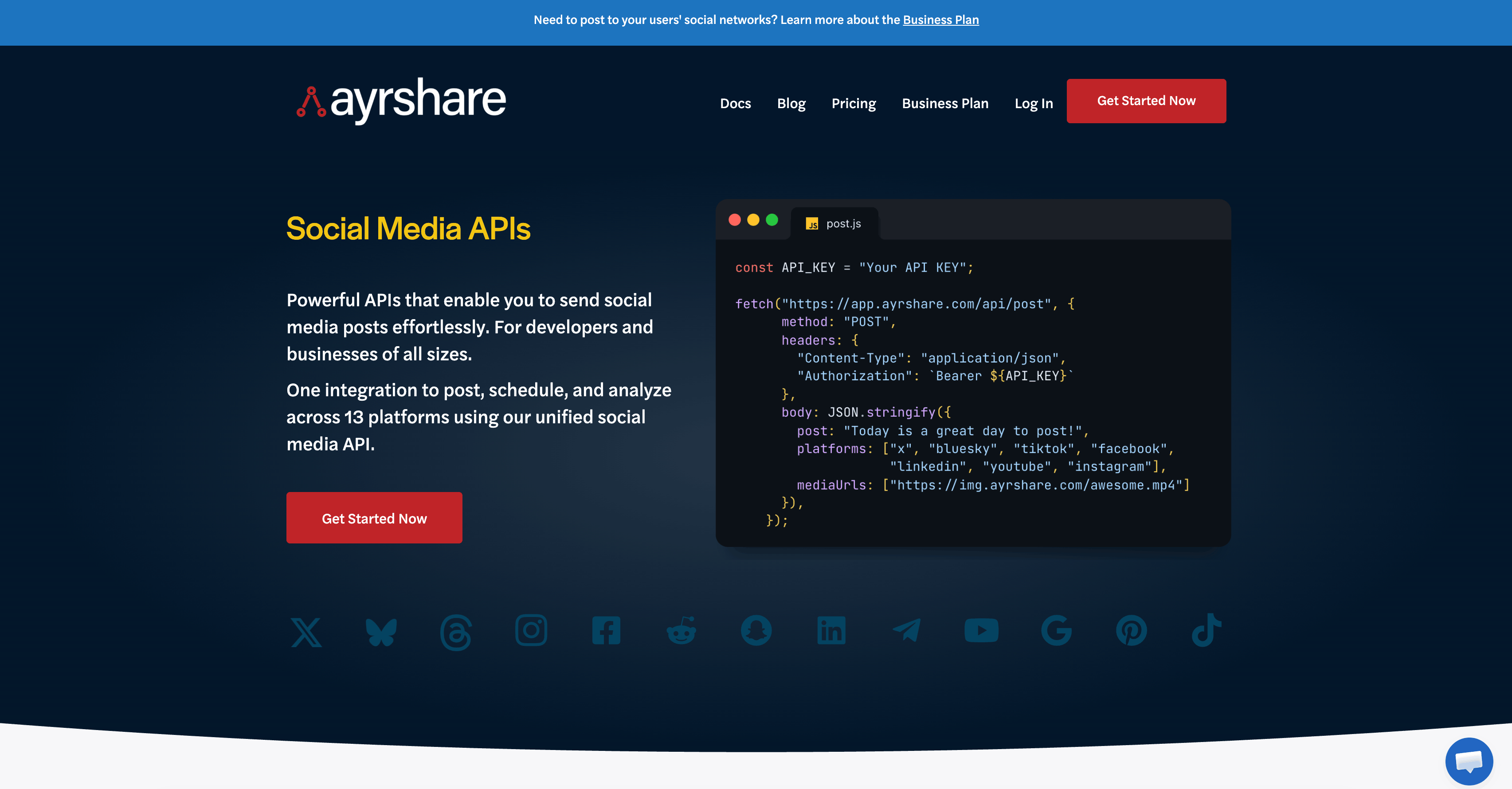
Platforms: TikTok, Instagram, Facebook, LinkedIn, X/Twitter, YouTube, Pinterest, Reddit, Telegram, Threads, Bluesky, Snapchat, Google Business Profile (13+ total)
Ayrshare is the platform-coverage king among posting APIs. If you need to post to Telegram, Discord, Bluesky, or Reddit alongside the usual suspects, Ayrshare is one of the few APIs that supports them all through a single integration.
Key Features
- 13+ network coverage - Posting support for every major network plus Telegram, Reddit, Google Business Profile, Snapchat, Threads, and Bluesky.
- Posting + scheduling - Create, schedule, and delete posts across all networks simultaneously. History endpoints expose detailed metadata.
- Comment management - Retrieve, post, and reply to comments on published content across supported networks.
- Review management - Respond to reviews on Facebook Pages and Google Business Profile through the API.
- Auto-hashtag generation - Suggests hashtags based on real-time popularity for the content you are publishing.
- Messaging + webhooks - Send DMs with text, image, and video. Receive webhook notifications for reactions, read receipts, and message events.
- Public account lookup - Retrieve public data for any account, useful for competitor monitoring.
- SDKs for 8 languages - Node.js, JavaScript, PHP, Python, C#, Go, Java, and Ruby on Rails.
- No-code integrations - Notion, Airtable, Make, Bubble - useful if your team wants to prototype without writing code.
Pricing
- Free - 1 social set, 20 posts/month.
- Premium - From $24.99/mo, 1 social set, unlimited posts per month.
- Business - From $149/mo, 5 social sets, multi-client/agency features.
- Enterprise - Custom, includes higher volumes and SLA.
Pricing scales with the number of active social profiles managed, which is predictable for SaaS products but can compound for agencies.
Pros
- The widest platform coverage in the "posting API" category (13+).
- Mature product with a long track record of handling platform approvals.
- SDKs in every major language - easy to integrate from any stack.
- Webhook support and message-level features most competitors lack.
Cons
- Documentation is dense; some endpoints have platform-specific quirks buried in footnotes.
- No native AI content generation (you bring your own).
- API-only - no UI if you also want dashboards for non-technical users.
- Per-profile pricing can escalate for agencies with many clients.
Best For
SaaS products and agencies that need to cover niche platforms (Telegram, Reddit, Bluesky, Snapchat) alongside mainstream ones, and want an API-first posting layer without opinionated UX.
3. Outstand - Best for Usage-Based Pricing
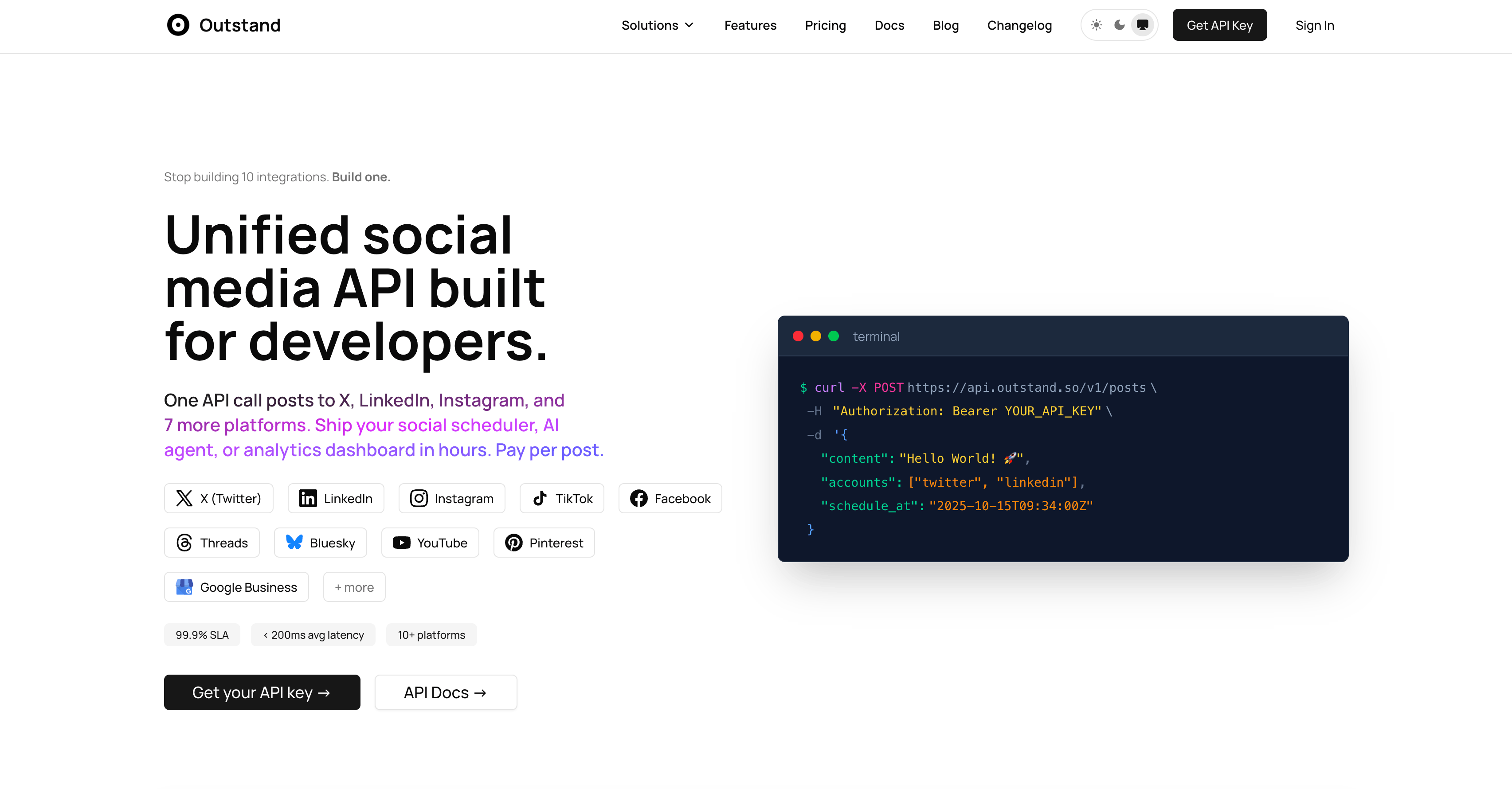
Platforms: X/Twitter, LinkedIn, Instagram, TikTok, Facebook, Threads, Bluesky, YouTube, Pinterest, Google Business (10+ total)
Outstand is one of the newer entrants but it differentiates sharply on pricing model and technical quality. Pure usage-based pricing with no seat licenses, no tiered plans, and no minimums. You pay a $5/mo base fee that includes 1,000 posts, then $0.01 per post beyond that.
Key Features
- Unified JSON schema - "Same JSON shape whether it came from X or TikTok. No more writing 10 parsers" is the core pitch. Analytics, posts, and metadata are normalized across all platforms.
- Single API endpoint for cross-posting - One request fans out to multiple networks simultaneously.
- Media processing - Images, videos, carousels, and stories are handled automatically with per-platform format adaptation.
- Timezone-aware scheduling - Schedule posts in any timezone; the API handles DST and platform-specific cutoff times.
- Webhook events - Real-time notifications for post status, engagement milestones, and OAuth token changes.
- Intelligent rate limiting - Automatic queuing and retries when upstream platforms throttle requests.
- MCP integration - 25 tools via Model Context Protocol, supporting Claude, Cursor, and Windsurf for AI-agent posting.
- OAuth and bring-your-own-credentials - Flexibility for white-label deployments.
Performance
Outstand publishes operational metrics: 99.92% measured uptime, 180ms average response latency, p50 at 120ms, p99 under 350ms. They claim 12.8M+ posts/month processed across 500+ companies.
Pricing
- Base - $5/month base fee includes 1,000 posts/month.
- Overage - $0.01 per post beyond 1,000.
- No seat licenses, no tiers. Volume discounts for 500k+ posts/month.
Pros
- Genuinely simple, predictable pricing ($0.01/post is easy to model).
- Strong MCP/AI-agent support out of the box.
- Clean unified JSON schema across all platforms.
- Published performance metrics (most competitors hide these).
Cons
- Analytics are aggregation-focused, not deep historical or competitor-level.
- No AI content generation.
- Smaller SDK ecosystem than Ayrshare or Buffer.
Best For
Startups, indie developers, and apps with variable posting volumes who want to avoid fixed monthly commitments. Also a great pick for AI agent builders who want MCP compatibility.
4. Upload-Post - Best Budget Option
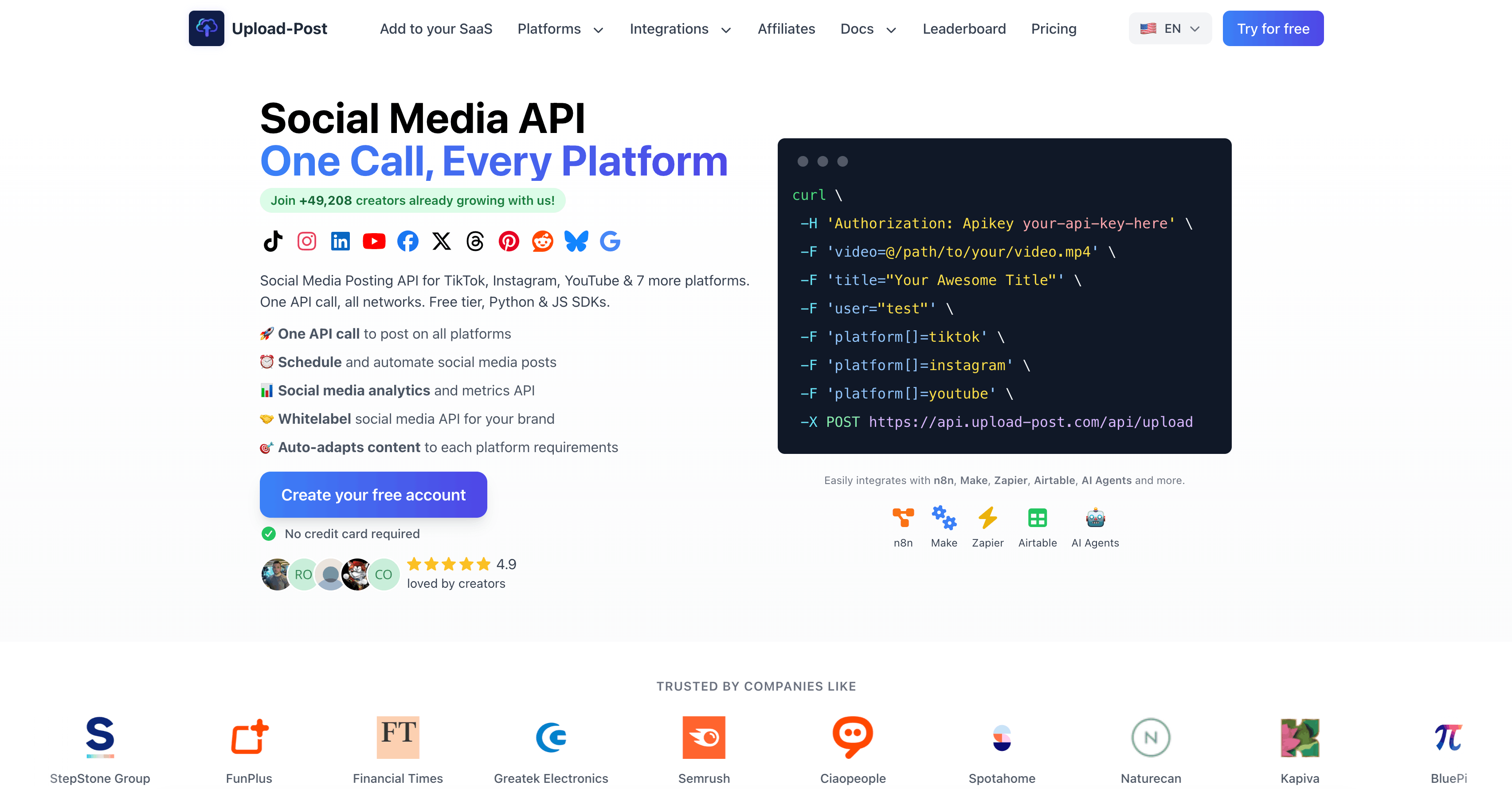
Platforms: TikTok, Instagram, YouTube, Facebook, LinkedIn, X/Twitter, Threads, Pinterest, Reddit, Bluesky, Google Business Profile (11 total)
Upload-Post offers one of the widest platform coverages at one of the lowest price points. Their free tier includes 10 uploads/month and 2 connected profiles, making it easy to test before committing.
Key Features
- Multi-platform distribution - One API call fans out across all connected networks.
- FFmpeg video processing - Built-in video editing API with monthly minute allocations (30-10,000 minutes depending on tier). You can trim, convert formats, apply watermarks, and re-encode without running your own FFmpeg.
- Auto-format adaptation - Videos are automatically adapted to each platform's aspect ratio, file size, and caption length requirements.
- Analytics - Views, likes, comments, and engagement metrics aggregated across platforms.
- Security model - Uses official platform APIs with OAuth, no scraping or grey-area workarounds.
- Whitelabel support - Available on Professional and above, letting agencies resell the API under their own brand.
- No-code integrations - Official n8n node, Make HTTP module, Zapier app, Airtable connector.
Pricing
| Plan | Price | Profiles | Uploads | Video Editing |
|---|---|---|---|---|
| Free | $0/mo | 2 | 10/mo | - |
| Basic | $16/mo | 5 | Unlimited | 300 min/mo |
| Professional | $33/mo | 25 | Unlimited | 1,000 min/mo + whitelabel |
| Advanced | $118/mo | 75 | Unlimited | 3,000 min/mo + priority support |
| Business | $350/mo | 225 | Unlimited | 10,000 min/mo + 10 team seats |
Pros
- Widest platform coverage at the cheapest paid tier ($16/mo for 11 networks).
- Built-in FFmpeg video processing - no need to self-host an encoder.
- Generous free tier for testing.
- No-code integrations (n8n, Make, Zapier) for non-developers.
Cons
- Analytics are basic (no competitor data, no historical depth).
- No AI content generation.
- UI/dashboard is lightweight compared to Buffer or Hootsuite.
Best For
Budget-conscious developers, content agencies, and creator tools that need broad platform support without enterprise pricing. Also good for teams that want n8n or Zapier workflows alongside direct API access.
5. PostForMe - Best for Quick SaaS Integration
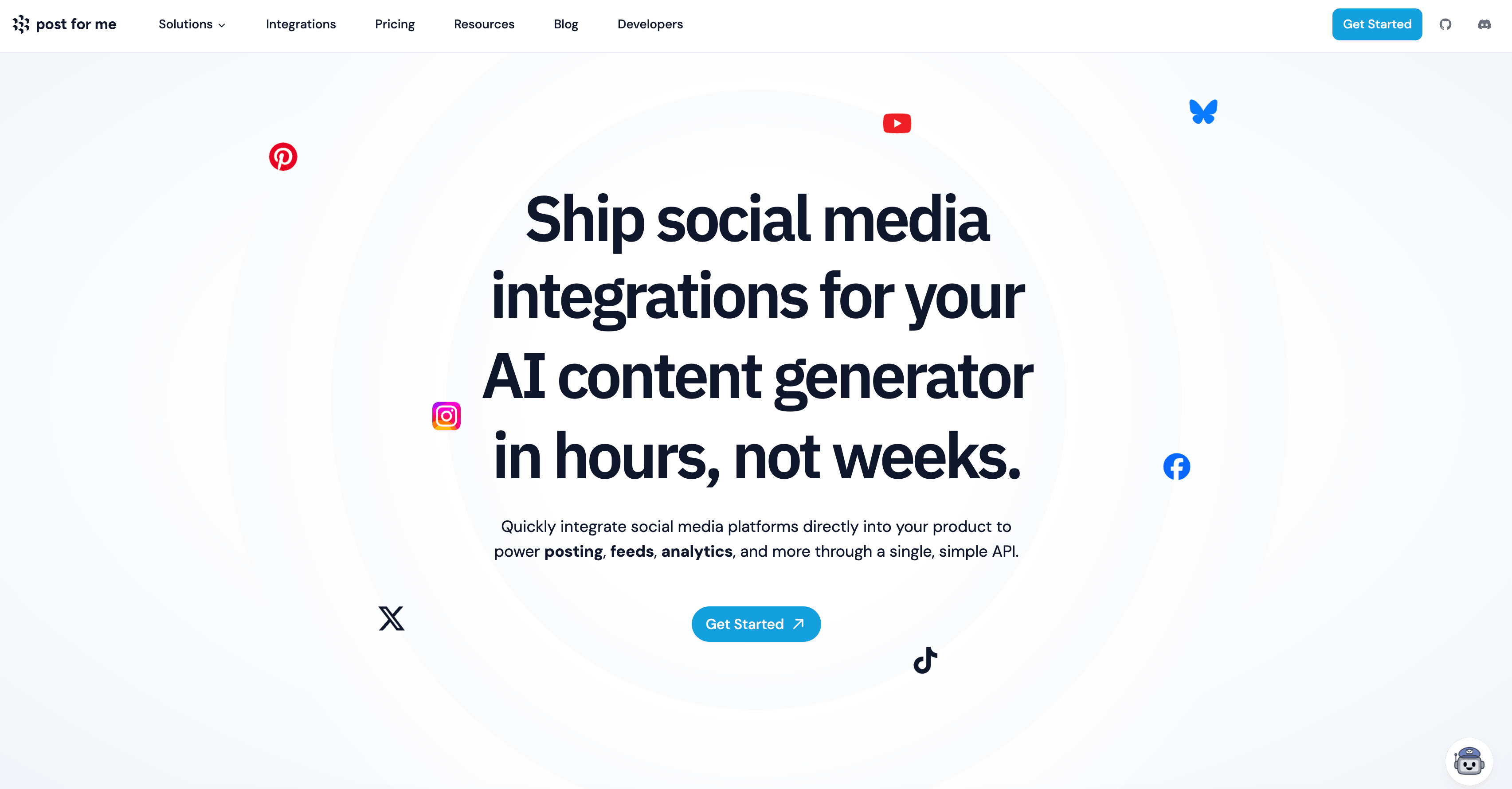
Platforms: TikTok, Instagram, Facebook, X/Twitter, LinkedIn, YouTube, Threads, Pinterest, Bluesky (9 total)
PostForMe is built specifically for SaaS developers who need to add social media features to their product fast. The headline claim - "ship social media integrations in hours, not weeks" - reflects their focus on speed-of-integration over feature depth.
Key Features
- Two deployment modes - Quickstart (use PostForMe's managed OAuth credentials for instant access, no platform approval needed) and White Label (bring your own credentials for full brand ownership in the OAuth consent screen).
- Social media feeds - Fetch and display content from connected accounts, useful for building creator dashboards or content inbox views.
- Post analytics - Track engagement metrics across all connected platforms.
- Unlimited social accounts - All plans include unlimited connected accounts, unlimited projects, unlimited API keys, and unlimited team members.
- Media processing + storage - Upload once, PostForMe handles platform-specific encoding and format conversion.
- Real-time webhooks - Post status changes, engagement updates, and OAuth events.
- SDKs - JavaScript, TypeScript, Python, Ruby, and Go.
Pricing
Pricing scales with total posts per month:
- $10/mo - 1,000 posts.
- Higher tiers - Scale up to $1,000/mo for enterprise volumes.
Both Quickstart and White Label projects use the same pricing tiers. No per-seat or per-account fees.
Pros
- Quickstart mode is genuinely useful for MVPs - skip weeks of Facebook and TikTok app review.
- Simple volume-based pricing with no hidden per-account fees.
- Clean developer experience with 5 SDKs.
- Feeds endpoint is a differentiator for creator dashboards.
Cons
- Fewer platforms than Ayrshare or Upload-Post (9 vs. 11-13).
- No AI content generation.
- Analytics depth is limited compared to Socialinsider or Data365.
Best For
SaaS builders who want to ship social media posting features quickly without managing OAuth credentials or waiting on platform approvals. Particularly good for B2B SaaS products that add social scheduling as a secondary feature.
6. Buffer API - Best for Established Scheduling
Platforms: Facebook, Instagram, LinkedIn, X/Twitter, TikTok, Pinterest, YouTube, Threads (8 total)
Buffer has been in the social media scheduling game since 2010 and their API reflects that maturity. Buffer is rebuilding their public API in 2026 (currently in beta) with a cleaner architecture, and paid accounts can generate up to 5 API keys directly from Buffer settings.
Key Features
- Content creation - Create posts with text, media (images and videos), and channel-specific features. Create text and image-only "ideas" (drafts).
- Queue + scheduling - Buffer's queue-based scheduling model (set time slots per channel, drop content into the queue) is the gold standard that most competitors copy.
- Data retrieval - Fetch profiles, scheduled posts, sent posts, user data, and engagement analytics.
- Canva integration - Design graphics in Canva and push directly to Buffer queue.
- Zapier integration - Connect Buffer with thousands of apps.
- OAuth authentication - Standard OAuth 2.0 flow.
- Rate limits - 60 authenticated requests per user per minute (HTTP 429 on overage; higher limits negotiable).
- JSON-only responses -
&pretty=truequery string for formatted output during testing.
Pricing
- Free - 3 channels, 10 scheduled posts per channel. 1 API key.
- Essentials - $5/mo per channel. Unlimited scheduled posts, advanced analytics. Up to 5 API keys on paid accounts.
- Team - $10/mo per channel. Team collaboration, approval workflows.
- Agency - Higher tier, custom pricing for client management.
Annual billing gives 20% off.
Pros
- Proven, reliable scheduling engine - Buffer is the grandfather of scheduling APIs.
- Per-channel pricing keeps costs predictable.
- Mature ecosystem (Zapier, Canva, Integromat/Make integrations).
- Free tier is genuinely useful for testing.
Cons
- API is built as an extension of the Buffer product, not as a developer-first surface - flexibility is limited.
- Currently rebuilding the public API, so feature parity with the web app is still catching up.
- No AI content generation.
- Per-channel pricing can be expensive for agencies with many clients.
Best For
Teams that already use Buffer and want to extend it with automation, or developers who want a rock-solid scheduling engine and are willing to work within Buffer's product opinions.
7. Hootsuite API - Best for Enterprise Management
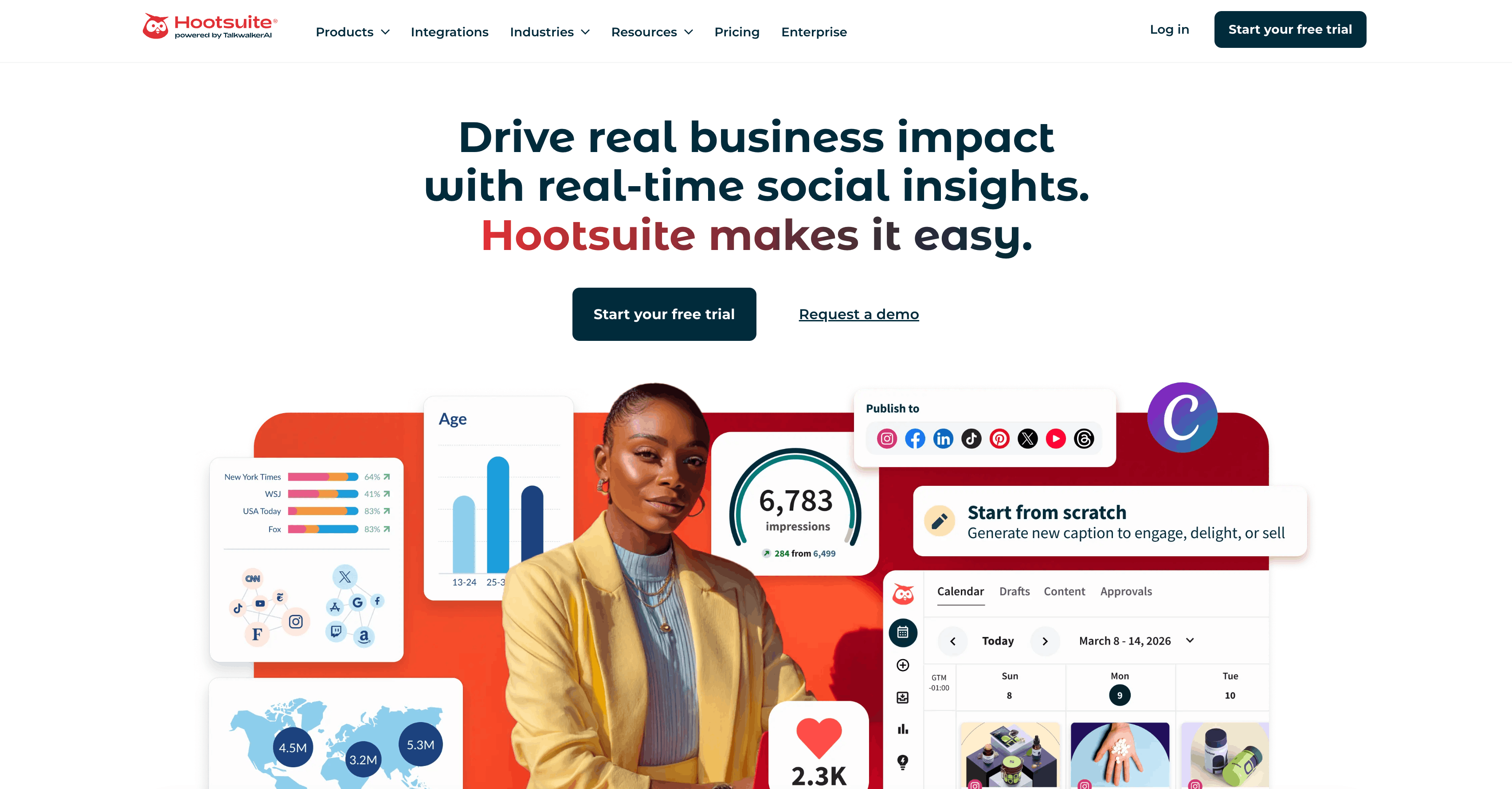
Platforms: Facebook, Instagram, LinkedIn, X/Twitter, TikTok, Pinterest, YouTube (7 total)
Hootsuite is one of the oldest and most recognized social media management platforms. Their API bundles with the full Hootsuite platform: scheduling, inbox management, social listening (powered by Talkwalker), employee advocacy, and team collaboration.
Key Features
- Full platform integration - The API is an extension of Hootsuite's enterprise dashboard, so programmatic actions flow through the same workflow, approval chains, and audit logs as manual work.
- Social listening - Talkwalker integration for brand monitoring, sentiment analysis, and competitor intelligence.
- Employee advocacy - Exclusive tools for programs where employees share company content on their personal accounts (rare feature among APIs).
- Inbox management - Unified inbox for comments, messages, and mentions across platforms; respond via API.
- Approval workflows - Multi-seat team management with approval chains and compliance features.
- SSO and SOC 2 - Enterprise-grade security with single sign-on, advanced permissions, and audit logs.
- Custom API access - Enterprise tier includes dedicated API support and custom integrations.
Pricing
- Standard - $199/seat/mo (annual) or $249/seat/mo (monthly). Limited API access.
- Advanced - $399/seat/mo (annual) or $499/seat/mo (monthly). More API features.
- Enterprise - ~$15,000-$16,000/year starting. Custom API access, SSO, SLA, dedicated account manager.
Pros
- Most mature enterprise feature set: approvals, compliance, audit logs, SSO, SOC 2.
- Social listening and employee advocacy features are rare in API offerings.
- Trusted by large organizations - if your procurement team knows Hootsuite, adoption is smoother.
Cons
- Expensive. The cheapest plan ($199/seat/mo) is more than most other APIs on this list combined.
- API is an add-on to the platform, not a first-class surface - feature flexibility is limited.
- Best features (custom API access, Employee Advocacy, advanced listening) gated behind Enterprise.
- No AI content generation.
- Per-seat pricing hurts small teams.
Best For
Large organizations (500+ employees) that already use Hootsuite and want API-level access to their existing workflow, or enterprises with strict compliance, SSO, and audit requirements that smaller APIs can't meet.
8. Socialinsider - Best for Deep Analytics Data
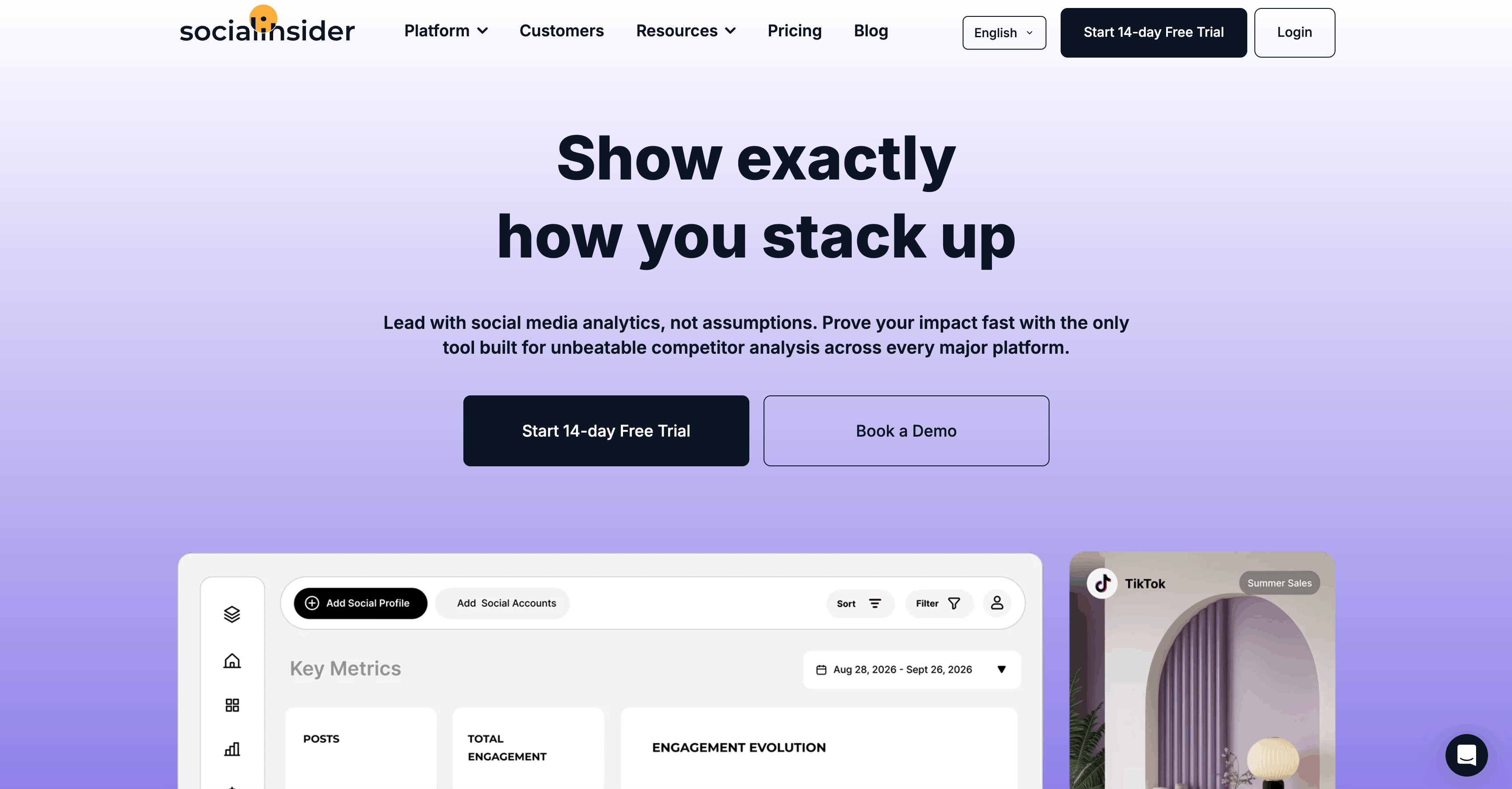
Platforms: Facebook, Instagram, X/Twitter, TikTok, LinkedIn, YouTube (6 total)
Socialinsider is a pure analytics API - no posting, no scheduling. If your use case is tracking competitors, monitoring influencers, or building analytics dashboards, Socialinsider provides some of the deepest social data available.
Key Features
- Post-level engagement metrics - Likes, comments, shares, saves, views, and engagement rate for every post on a tracked account.
- Profile performance data - Follower growth, reach, impressions, and account-level trends.
- Historical depth - Up to 12 months of historical data per profile for trend analysis and benchmarking.
- Video analytics - Watch time, average view duration, and drop-off curves for video posts (where supported by the platform).
- Private metrics - For owned accounts, returns private metrics (reach, impressions, saves) that aren't visible via public data.
- 6-hour refresh - Near real-time with 6-hour refresh intervals on tracked profiles.
- No API rate limits - Pricing is per-handle tracked, not per API call, so you can query as often as you like.
- 99.99% uptime - Published SLA.
- 3-month POC option - Proof-of-concept period with zero long-term commitment.
Pricing
- Starting plans - $83/mo (annual) for 10 social profiles (no API).
- Professional - $166/mo, more profiles, no API.
- Advanced - $333/mo. API access included. Unlimited API calls. Pay per tracked handle.
- Enterprise - Custom. Volume discounts for tracking thousands of profiles.
Pros
- Deepest historical analytics data on this list (12 months).
- Per-handle pricing is predictable if you know your account count.
- No API rate limits - unusual and useful.
- Private metrics for owned accounts.
Cons
- Analytics only. No posting, scheduling, or content creation.
- API access only on Advanced ($333/mo) and above.
- Handles-only model means you can't query by keyword or hashtag.
- 6 platforms (no Pinterest, Threads, Bluesky, Reddit).
Best For
Agencies and analytics platforms that need deep historical social data for competitor analysis, influencer monitoring, or custom dashboards. Also great for BI teams feeding social data into existing reporting stacks.
9. Data365 - Best for Data Collection
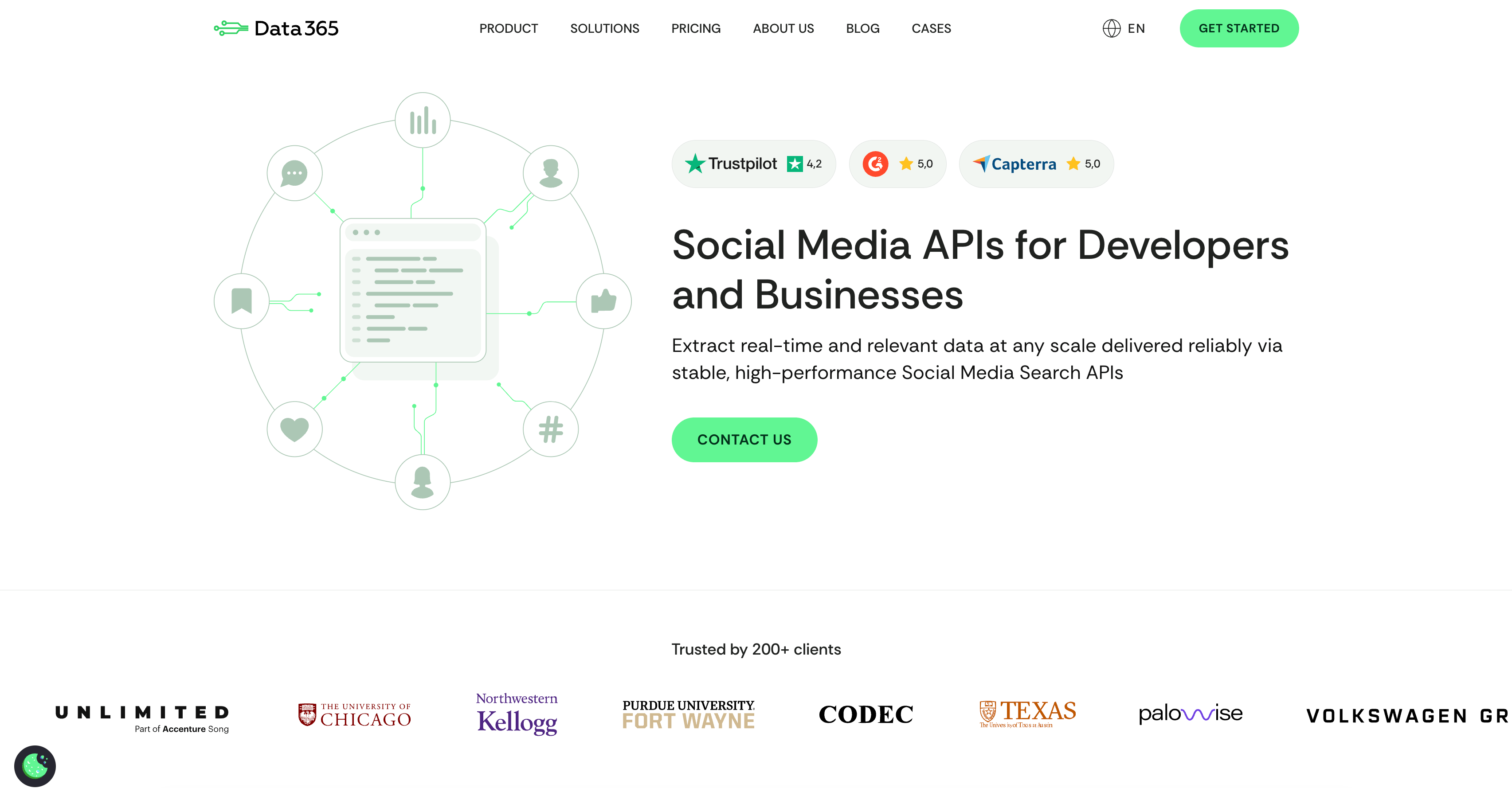
Platforms: Instagram, X/Twitter, Reddit, TikTok, Facebook, Threads (6 total)
Data365 is a data retrieval API focused on collecting and normalizing social media data at scale. It covers profiles, posts, comments, and engagement metrics across six platforms with a consistent schema - no matter which platform the data comes from, the response format is the same.
Key Features
- Real-time collection - Data is gathered live at request time, not from a pre-built cache. Requests use a two-step flow: POST to initiate collection, GET to retrieve once ready.
- Comprehensive datasets - Profiles (usernames, follower counts, verification status, avatars), posts (caption, media, timestamps), comments (text, author, engagement), and account-level metrics.
- Consistent schema across platforms - Same normalized shape for a TikTok post and an Instagram post. Great for analytics pipelines that can't afford to write 6 parsers.
- 99.9% uptime - Published infrastructure reliability.
- Access-token auth - Simple REST authentication.
- Postman workspace - Full Postman collection published, which accelerates first-day integration.
- Custom endpoints - They will build platform-specific endpoints for enterprise customers with unique needs.
- 8+ years of specialized expertise - Long track record of adapting quickly to platform changes.
Pricing
- Pay-as-you-go - Volume-based, transparent tiers. Not self-serve; contact sales for exact pricing.
- Free trial - Available on request.
- Scales to millions of records per customer.
Pros
- Excellent schema normalization across platforms.
- Real-time (not cached) data gathering.
- Responsive personal customer support - they'll build custom endpoints.
- 8 years of platform-change expertise means less breakage.
Cons
- Not self-serve - requires a sales conversation to get pricing.
- No posting capabilities - read-only.
- 6 platforms (no LinkedIn, Pinterest, YouTube).
- Async (POST then GET) flow requires more client code than a standard REST API.
Best For
Data engineers, researchers, and ML teams who need structured, normalized social media data at scale for analysis, training datasets, market research, or competitor monitoring pipelines.
10. SociaVault - Best Free Option for Data Extraction
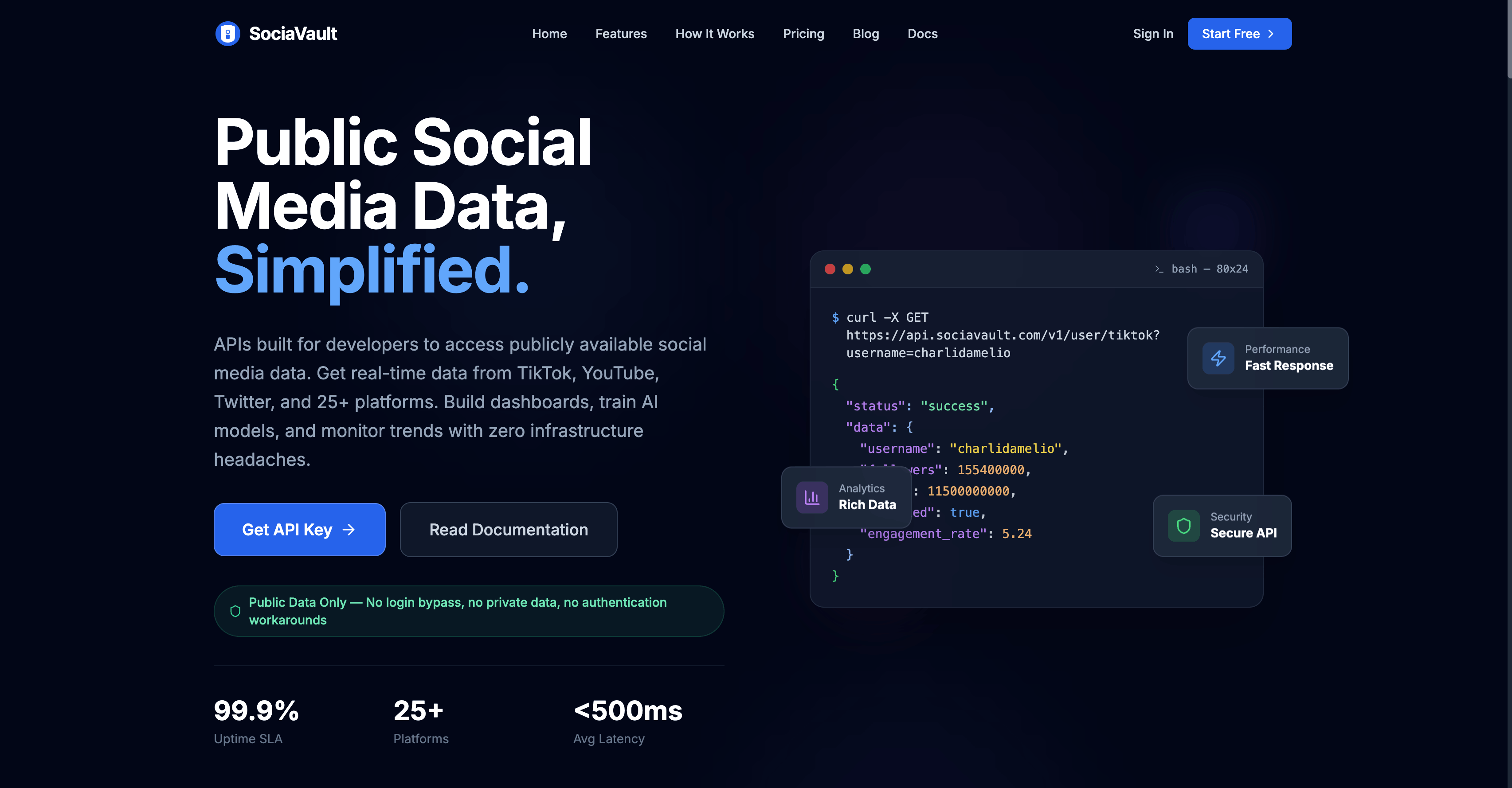
Platforms: TikTok, Instagram, YouTube, X/Twitter, LinkedIn, Facebook, Reddit, Threads, Pinterest, Snapchat, Google, Bluesky, Truth Social, and 12+ more (25+ total)
SociaVault claims the widest platform coverage of any API on this list - 25+ social networks through a single API key. It is a data extraction API (no posting), focused on pulling profiles, posts, and engagement metrics from public accounts in real time.
Key Features
- 25+ platforms - TikTok, YouTube, Twitter/X, Reddit, Pinterest, Google, Snapchat, Bluesky, Truth Social, plus 15+ more explicitly listed.
- Under 500ms average latency - Fast responses suitable for real-time dashboards.
- 99.9% uptime SLA - Auto-scaling infrastructure.
- No rate limits on concurrent requests - Parallelize freely.
- Simple auth - Single header (
X-API-Key). No OAuth complexity for data reads. - Credit system - 1 request = 1 credit, transparent endpoint pricing in docs.
- Free tier with 50 credits - No credit card required. Credits never expire.
Pricing
| Plan | Price | Credits | Per-Credit |
|---|---|---|---|
| Free Trial | $0 | 50 | - |
| Starter Pack | $29 | 6,000 | $0.0048 |
| Growth Pack | $79 | 20,000 | $0.0040 |
| Pro Pack | $199 | 75,000 | $0.0027 |
| Enterprise | $399 | 200,000 | $0.0020 |
No subscription required. All packs are one-time purchases that never expire.
Pros
- Widest platform coverage of any API on this list (25+).
- Credits never expire - rare in the industry.
- No subscription, no minimum commitment.
- Free tier (50 credits) is enough to test realistic workflows.
- Sub-500ms latency is genuinely fast.
Cons
- Read-only. No posting, no scheduling, no content creation.
- Free tier (50 credits) is not enough for production.
- Some platforms only have partial endpoint coverage - check their docs.
- Smaller company than Ayrshare or Hootsuite; ecosystem is thinner.
Best For
Developers who need a free starting point for social media data extraction, competitor monitoring, sentiment analysis, or feeding social data into analytics tools. Also the cheapest way to get data from long-tail platforms (Truth Social, Snapchat, Bluesky) through a single API.
Capability Matrix
Quick at-a-glance view of what each API can actually do:
| API | Post | Schedule | Read Analytics | AI Content | Workspace Isolation | AI Agent Skill | Webhooks |
|---|---|---|---|---|---|---|---|
| Genviral | Yes | Yes | 3 platforms | Yes | Yes | Yes (OpenClaw, 47 cmds) | Limited |
| Ayrshare | Yes | Yes | Yes | Basic | Partial | - | Yes |
| Outstand | Yes | Yes | Yes | - | Partial | Yes (MCP) | Yes |
| Upload-Post | Yes | Yes | Yes | - | Whitelabel | - | Yes |
| PostForMe | Yes | Yes | Yes | - | Projects | - | Yes |
| Buffer | Yes | Yes | Yes | - | Accounts | - | Limited |
| Hootsuite | Yes | Yes | Yes | - | Enterprise | - | Yes |
| Socialinsider | - | - | Yes | - | Handles | - | Limited |
| Data365 | - | - | Yes | - | - | - | - |
| SociaVault | - | - | Yes | - | - | - | - |
What About Native Platform APIs?
You can always integrate directly with each platform's own API. Here is a quick reality check on what that actually involves in 2026:
| Platform | Difficulty | Key Pain Points |
|---|---|---|
| Facebook Graph API | Hard | Rigorous app review (video screencast demo required), often rejected multiple times, can only post to Pages (not personal profiles), Business Verification required. |
| Instagram Graph API | Hard | Inherits Facebook's approval process, multi-step async uploads, 50 posts/24hr rolling limit, JPEG only for images (no PNG), no Stories or Reels for most scopes. |
| TikTok API | Hard | Async uploads (no immediate video ID), webhook required for completion, domain verification mandatory, docs have known errors, approval takes weeks. |
| LinkedIn API | Hard | Docs mix v1/v2 inconsistently, confusing scope approval flow, tokens expire in 60 days with no refresh on some scopes, LinkedIn Marketing API is gated behind partner application. |
| YouTube Data API | Medium | Manageable approval, solid docs, but the 10,000-unit daily quota can be restrictive (uploads cost 1,600 units each). |
| Pinterest API | Easy | Well-organized docs, quick approval, simple endpoints - the easiest native API on this list. |
| X/Twitter API | Medium-Hard | Paid tiers start at $200/mo and scale to $42,000+/mo, incomplete v2 API (still need v1.1 for some media operations), Elon-era changes make long-term planning hard. |
For most use cases, a unified API saves 2-6 months of development time up front and eliminates ongoing maintenance when platforms change their endpoints, authentication flows, or rate limits.
Security and Authentication Considerations
Every social media API you integrate with is a potential blast radius. A leaked API key or compromised token can let an attacker post on behalf of your users, delete content, or exfiltrate their data. Before picking an API:
- Rotate keys regularly - Most APIs let you issue multiple keys and revoke individually. Use separate keys per environment (dev, staging, prod) and per service.
- Scope keys narrowly - If an API supports scoped keys (read-only, post-only, workspace-only), always use them. Genviral supports workspace-scope keys so a leaked key can't touch another tenant.
- Rotate OAuth refresh tokens - TikTok and LinkedIn tokens expire in 60 days. Build refresh flows into your scheduler, not as an afterthought.
- Audit logs - APIs with audit logs (Hootsuite Enterprise, Genviral workspace logs) let you trace "who posted what" for compliance.
- Webhook signature verification - Always verify webhook HMAC signatures. A webhook endpoint that accepts unsigned payloads is a denial-of-service vector.
- Rate limits as safety rails - Even if an API doesn't rate-limit you strictly, your code should. Upstream platform limits can cascade into account suspensions if hit.
How to Choose
Building a SaaS product? Start with PostForMe (Quickstart mode) or Outstand (usage-based) for fast MVP shipping. You skip platform approval and pay only for what you use. Migrate to Genviral or Ayrshare when you need content creation or broader platform coverage.
Running an agency? Genviral with workspace-scoped API keys lets your team create, schedule, and track content for multiple clients from one integration. You can schedule to TikTok, Instagram, YouTube, Facebook, Pinterest, and LinkedIn from a single dashboard or API call. Upload-Post is a budget alternative if you only need posting.
Building analytics dashboards? Socialinsider for deep historical data (12 months) and private metrics on owned accounts, or Data365 for real-time streaming and data normalization across profiles, posts, and comments. SociaVault if you are on a budget or need long-tail platforms (Truth Social, Snapchat, Bluesky).
Automating content with AI agents (Claude Code, Cursor, Codex)? Genviral is the only API on this list with native AI content generation (images, videos, slideshows), an OpenClaw skill with 47 commands, and TikTok trend-brief endpoints. Your agent can research trends, generate content, post it, and measure results through one API. Outstand is a solid alternative for MCP-native posting without AI generation.
Need maximum platform coverage? Ayrshare (13+ platforms including Telegram, Reddit, Google Business, Snapchat), Upload-Post (11 platforms including Bluesky, Reddit, Google Business), or SociaVault (25+ platforms, read-only).
Enterprise with strict compliance? Hootsuite Enterprise is the only option here with SSO, audit logs, employee advocacy, and SOC 2 at scale. Budget $15k+/year.
FAQ
What is a social media API?
A social media API is a programming interface that lets applications interact with social media platforms programmatically - posting content, fetching analytics, managing accounts, and automating workflows without manual interaction. Instead of logging into each platform's website, your code talks directly to their servers (or to a unified aggregator API that wraps them all).
Do I need a unified API or can I use platform APIs directly?
You can use platform APIs directly, but each has its own OAuth flow, rate limits, content format requirements, and approval process. Integrating with six platforms means maintaining six separate integrations - plus keeping up with breakage every time one of them deprecates an endpoint or changes authentication. A unified API abstracts this into a single integration. For most products, the time and maintenance savings easily outweigh the API cost. If you only ever plan to post to one platform (say, Pinterest), going direct is fine.
Which social media API is best for AI agents?
Genviral is the only API on this list built specifically for AI agent workflows. It includes an OpenClaw social media skill with 47 commands, a consistent { ok, code, message, data } response envelope for easy parsing, external_id idempotency on POST /posts for safe retries, and AI content generation endpoints for images, videos, and slideshows. Claude Code, Cursor, and Codex can research trends, create content, post it, and analyze results through a single integration. Outstand is a solid alternative if you only need posting (via MCP, 25 tools).
How much does a social media API cost?
Pricing varies widely in 2026. PostForMe starts at $10/mo for 1,000 posts. Upload-Post is $16/mo for unlimited posts on 5 profiles. Buffer starts at $5/mo per channel. Outstand is usage-based at $5/mo + $0.01/post. Genviral starts at $29/mo with 200 credits. Ayrshare starts at $24.99/mo. Enterprise tools like Hootsuite start at $199/seat/mo and scale to $15k+/year for custom plans. Analytics-only APIs (Socialinsider, Data365) use per-handle or custom pricing. Most offer free tiers or trials.
Can I post to TikTok via API?
Yes, but TikTok's native API has a notoriously difficult approval process and requires async uploads with webhooks, domain verification, and a partner review that can take weeks. Unified APIs like Genviral, Ayrshare, Upload-Post, and PostForMe handle all of this for you - including TikTok slideshow/carousel publishing (up to 35 images) which most APIs skip because of its complexity.
What is the best free social media API?
For posting, Upload-Post's free tier (10 uploads/month, 2 profiles) and Buffer's free tier (3 channels, 10 scheduled posts each) are the most generous. For data extraction, SociaVault offers 50 free credits with no expiry. For full-featured testing, most unified APIs (Ayrshare, PostForMe, Outstand, Genviral) offer trial credits or free tiers so you can validate the integration before paying.
Which API handles Instagram Reels and Stories?
Reels and Stories are notoriously limited in the Instagram Graph API. Genviral, Ayrshare, and Upload-Post support Reels publishing. Stories via API are extremely rare - Instagram gates Stories behind Instagram Login scopes that most aggregator APIs don't have. If Stories posting is mission-critical, plan to use the Instagram mobile app or a hosted-account automation layer.
Can I delete posts via API?
Ayrshare supports deleting posts across all connected networks simultaneously. Genviral, Upload-Post, and PostForMe support deletion on a subset of platforms (rules vary - YouTube and Facebook are usually supported; TikTok and Instagram deletion is often limited to draft/scheduled content).
Which API has the best analytics?
For deep historical data and private metrics: Socialinsider (12 months history, 6-hour refresh, unlimited API calls). For normalized cross-platform data: Data365. For 25+ platforms including long-tail: SociaVault. For posting + basic analytics combined: Genviral and Ayrshare.
How do I handle OAuth token expiration?
All major platform tokens expire eventually. LinkedIn and TikTok tokens expire in 60 days. Facebook/Instagram tokens can be long-lived (60+ days) but require periodic refresh. The best unified APIs (Genviral, Ayrshare, PostForMe) handle token refresh automatically and expose the current connection status via API or webhook. If you go direct to platforms, build refresh flows into your scheduler from day one.
Key Takeaways
- Unified social media APIs save 2-6 months of engineering time up front and eliminate ongoing platform-breakage maintenance. For any product posting to 3+ platforms, they are almost always worth the cost.
- Genviral is the only API that covers the full pipeline - AI image/video/slideshow generation, cross-platform posting, analytics on TikTok/Instagram/YouTube, TikTok trend briefs, and 5-200 item video Bulk Creation campaigns - in one integration with a 47-command OpenClaw skill.
- Ayrshare wins on platform breadth (13+ networks) but is posting-only and requires you to bring your own content.
- Outstand has the most developer-friendly pricing ($5/mo + $0.01/post) and published performance metrics, making it ideal for apps with variable posting volumes.
- Upload-Post is the cheapest paid option ($16/mo for 11 platforms) and includes built-in FFmpeg video processing.
- Analytics-only APIs (Socialinsider, Data365, SociaVault) handle a different job: they read data but don't post. Pair them with a posting API if you need both.
- Hootsuite is overkill unless you are a large enterprise with compliance, SSO, and audit requirements. Budget $15k+/year.
- For AI agent workflows, Genviral (OpenClaw skill, 47 commands) and Outstand (MCP, 25 tools) are the two APIs built for autonomous agents in 2026.
Related Guides
- How to Use OpenClaw to Automate Your Social Media
- 15 Best OpenClaw Skills for Social Media Marketing
- How to Schedule TikTok Posts
- How to Schedule Instagram Posts
- How to Schedule Pinterest Posts
- How to Schedule YouTube Posts
- How to Schedule Facebook Posts
- How to Schedule LinkedIn Posts
- AI Agents for Social Media
Genviral is an AI-powered social media platform with a REST API and OpenClaw skill for autonomous content creation, scheduling, and analytics across TikTok, Instagram, YouTube, Facebook, Pinterest, and LinkedIn. Get started →

Fekri
Builder, founder, father