social-media
tutorial
How to Find Group Boards on Pinterest (2026 Complete Guide)

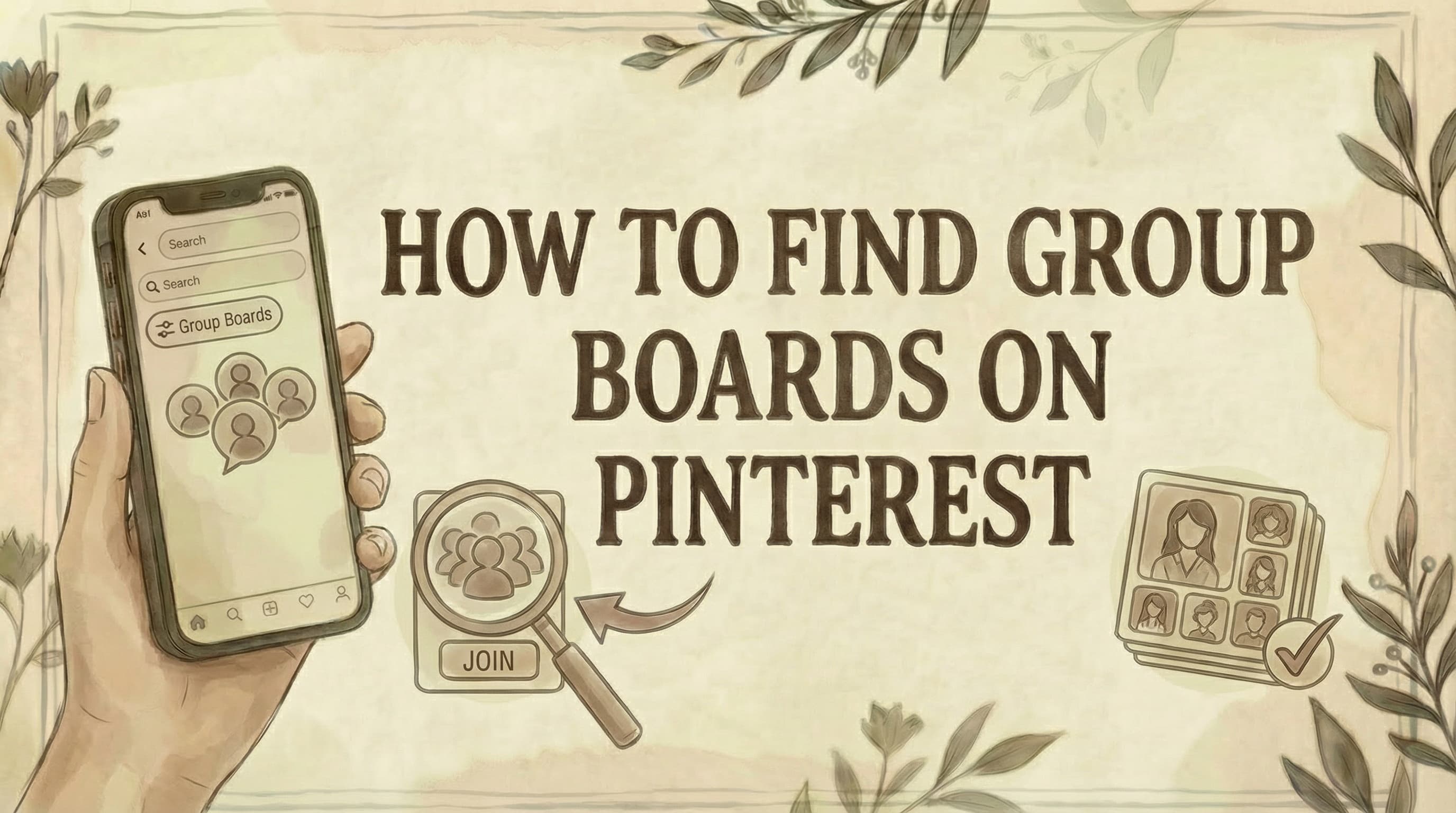
- Group boards are identified by multiple overlapping profile icons instead of one - search your niche keyword in Pinterest, filter by Boards, and look for that multi-avatar indicator.
- For new accounts under 1,000 followers, joining group boards is still a viable way to get initial content distribution; for established accounts, optimizing your own boards has more impact.
- PinGroupie.com is the most efficient way to find and filter group boards by category, follower count, and activity level before requesting to join.
Pinterest group boards are easy to spot once you know what to look for. This guide covers six proven methods to find the right ones for your niche - from Pinterest's own search to dedicated third-party tools.
What Are Pinterest Group Boards?
Group boards (also called collaborative boards) are Pinterest boards with multiple contributors who can all add pins to the same board.
Visual identification:
- Regular board: Single profile picture
- Group board: Circle with multiple small profile pictures overlapping
Key characteristics: ✅ Multiple people can pin content ✅ Board owner controls permissions ✅ Often have more followers than regular boards ✅ Can have dozens (or hundreds) of contributors ✅ Used for collaboration and expanding reach
Example: A "Healthy Recipes" group board might have 50 food bloggers all pinning their recipes, giving each contributor access to the board's 10,000 followers.
Group boards vs. private boards: Group boards are designed for public reach with multiple contributors. If you want the opposite - a board only you and a small invited group can see - see how to make a board on Pinterest private.
Why Find Group Boards? (Are They Still Worth It in 2026?)
The truth: Group boards are less powerful than they were in 2018-2020, but they're NOT dead.
When Group Boards Are Worth It:
For new Pinterest accounts:
- You have under 1,000 followers
- You're building initial authority
- You need exposure beyond your own audience
For time-sensitive content:
- Seasonal recipes (holiday content)
- Event planning boards
- Product launches
- Trending topics
For niche collaboration:
- Connecting with peers in your industry
- Building relationships with other creators
- Finding content creation partners
When to Skip Group Boards:
❌ Your own boards already perform well ❌ You have a strong follower base (5,000+) ❌ Group boards are low-quality or spammy ❌ You don't have time to manage them
The modern strategy: Quality over quantity. Join 5-7 highly relevant, active group boards rather than 50 random ones.
How to Identify Group Boards Visually
Before searching, you need to recognize them.
On Desktop:
Group board indicators:
- Multiple profile icons - Small circular icon showing 2-3 profile pictures
- Collaborator count - Shows number of contributors
- "Join" button - Some boards display this if accepting members
Regular board:
- Single profile picture
- Only the owner's name
On Mobile (iOS/Android):
Look for:
- Circular icon at bottom corner of board thumbnail
- Multiple tiny profile pictures inside the circle
- This appears on the board preview before clicking
Inside the Board:
Once you open any board:
- Collaborators section shows all contributor names
- First profile picture = board owner (always)
- Remaining pictures = collaborators
Method 1: Pinterest Native Search (Free, Built-In)
The most straightforward method using Pinterest itself.
Desktop Instructions:
Step 1: Go to Pinterest.com
- Log into your account
Step 2: Use the Search Bar
- Type your niche keyword
- Examples: "food blogging", "travel tips", "home decor", "digital marketing"
- Start broad, then narrow
Step 3: Filter Results to Boards
- Look at the dropdown menu next to search bar
- Currently shows "All Pins" by default
- Click it to reveal options
- Select "Boards"
Step 4: Browse Results
- Scroll through board results
- Look for the multiple-profile-icon indicator
- Group boards will have this circle icon
Step 5: Evaluate Each Board
- Click on promising boards
- Check number of collaborators
- Review recent pins (are they active?)
- Read board description for join instructions
Mobile Instructions (iOS/Android):
Step 1: Open Pinterest App
- Tap search icon (magnifying glass)
Step 2: Enter Keyword
- Type your niche
- Example: "vegan recipes"
Step 3: Filter to Boards
- Tap "All Pins" dropdown at top
- Select "Boards" from menu
Step 4: Scroll and Identify
- Look for boards with the circular multi-profile icon
- This appears at bottom-left of board thumbnail
- Tap boards to see details
Step 5: Check Board Details
- Number of pins
- Number of followers
- Collaborator list
- Join instructions in description
Tips for Better Search Results:
Use specific keywords:
- ❌ Too broad: "food"
- ✅ Better: "healthy meal prep"
- ✅ Even better: "keto meal prep recipes"
Try variations:
- "blogging tips group board"
- "travel bloggers collaborative board"
- "photography board with contributors"
Leverage autosuggest:
- Pinterest shows related searches
- Click these to discover niche-specific boards
Method 2: PinGroupie (Most Popular Tool)
Website: pingroupie.com Cost: Free Best for: Quick searching with detailed stats
What PinGroupie Shows:
- Board name and description
- Number of followers
- Number of collaborators
- Number of pins
- Average repins
- Last updated date
- Direct link to board
How to Use PinGroupie:
Step 1: Go to pingroupie.com
- No account required
Step 2: Choose Search Method
Option A - Category Search:
- Click "Category" dropdown
- Select from 30+ categories:
- Food & Drink
- Travel
- Fashion
- Home Decor
- Business
- Technology
- etc.
- Click "Filter"
Option B - Keyword Search:
- Enter keyword in "Title" field
- Or enter keyword in "Description" field
- Or search both
- Click "Filter"
Step 3: Apply Filters
- Enable "Request to Join" filter (highly recommended)
- Enable "Exclude Stale Boards" (removes inactive boards)
- These filters save massive time
Step 4: Sort Results
- Click "OrderBy" dropdown
- Sort by:
- Followers (most popular)
- Pins (most active)
- Collaborators (size of team)
- Average Repins (engagement)
- Followers/Collaborators Ratio (efficiency)
Step 5: Analyze Boards
- Click board title to open on Pinterest
- Click creator icon to see owner profile
- Hover over description for details
PinGroupie Pro Tips:
✅ Always enable "Request to Join" filter - These boards have clear instructions ✅ Exclude stale boards - Saves time on dead boards ✅ Sort by followers first - Start with popular boards ✅ Check follower-to-collaborator ratio - Aim for 50:1 or higher
Warning: PinGroupie's "Last Updated" shows when PinGroupie crawled the board, NOT when the board was last active. Always verify activity on Pinterest.
Method 3: Follow Successful Competitors
The "spy on your peers" strategy.
How It Works:
Find successful Pinterest users in your niche → see which group boards they've joined → join the same boards.
Step-by-Step Process:
Step 1: Identify Top Pinners in Your Niche
- Search your main keyword on Pinterest
- Look at who ranks highly
- Check who has 10,000+ followers
- Find 5-10 relevant accounts
Step 2: Visit Their Profile
- Click on their profile picture
- Go to their full profile page
Step 3: Click "Saved" Tab
- Shows all boards they own and contribute to
- Scroll through their boards
Step 4: Identify Group Boards
- Look for the multi-profile icon
- Group boards appear mixed with personal boards
- They're often at the bottom of the profile
Step 5: Click on Group Boards
- Open each group board
- Check if it's still active
- Check if accepting new members
- Read description for instructions
Step 6: Create a Spreadsheet
- Board name
- URL
- Number of followers
- Number of collaborators
- Join instructions
- Owner contact info
- Applied? (Yes/No)
- Status (Pending/Accepted/Rejected)
Why This Method Works:
- Pre-vetted quality - If successful pinners joined, boards are likely good
- Niche-relevant - Boards match your exact industry
- Competitor analysis - See what's working for others
- Discover hidden gems - Find boards not in directories
Method 4: Facebook Groups for Bloggers
Many Pinterest users share group boards in Facebook communities.
How to Use Facebook Groups:
Step 1: Search Facebook for Groups
- "Pinterest group boards"
- "[Your niche] Pinterest group boards"
- "Blogger Pinterest collaboration"
- "Pinterest marketing for [your industry]"
Step 2: Join Relevant Groups
- Look for active groups (100+ members)
- Read group rules
- Answer membership questions
Step 3: Search Within Groups
- Use group search function
- Search "group board"
- Search "collaborative board"
- Search "open board"
Step 4: Look for Pinned Posts
- Many groups have dedicated threads
- "Share your group boards here"
- "Open group boards list"
Step 5: Post Your Own Request (Optional)
- "Looking for [niche] group boards accepting contributors"
- Share what you offer in return
- Be specific about your niche
Recommended Facebook Groups:
- Blogger group boards for your specific niche
- Pinterest marketing communities
- Content creator collaboration groups
- Niche-specific blogging groups
Method 5: Check Board Owner Profiles
When you find ONE good group board, use it to find MORE.
The Strategy:
Step 1: Find a Quality Group Board
- Use any method above
Step 2: Identify the Board Owner
- Click on the board
- Board owner = first profile picture shown
- Usually listed first in URL
Step 3: Visit Owner's Profile
- Click their profile picture
- Go to their main Pinterest page
Step 4: Browse Their Boards
- Scroll through all their boards
- Successful group board owners often manage MULTIPLE group boards
- Or they're members of many others
Step 5: Evaluate Their Other Boards
- Click each group board they own/contribute to
- Check if relevant to your niche
- See if accepting members
Why this works: People who manage one successful group board often manage several or know the community well.
Method 6: Google Search for Curated Lists
Bloggers frequently publish "top group boards" lists.
How to Search:
Google search terms:
- "Pinterest group boards for [your niche] 2025"
- "Best Pinterest group boards for [your niche]"
- "Open Pinterest group boards list"
- "[your niche] Pinterest group boards to join"
Examples:
- "Pinterest group boards for food bloggers"
- "Best travel Pinterest group boards 2025"
- "Open Pinterest group boards for digital marketing"
What You'll Find:
- Blog posts with 50-100 curated boards
- Board links organized by category
- Recent updates (look for 2024-2025 posts)
- Sometimes join instructions included
Caution:
❌ Many lists are outdated ❌ Boards may be closed to new members ❌ Some boards are now inactive ✅ Use as starting point, verify on Pinterest
How to Evaluate Group Boards (Before Joining)
NOT all group boards are created equal. Many are low-quality.
Quality Indicators (Green Flags):
✅ Active recent pins - Pins added in last 7 days ✅ Clear board description - Explains the theme ✅ Join instructions provided - Contact info or button ✅ High follower count - 1,000+ followers minimum ✅ Reasonable collaborator count - 10-100 (not 1,000+) ✅ Good follower-to-collaborator ratio - At least 50:1 ✅ Quality pins - Well-designed, relevant content ✅ Engaged community - Comments, repins visible ✅ Niche-specific - Focused topic, not generic
Red Flags (Avoid):
❌ No recent activity - Last pin is months old ❌ Spam content - Off-topic pins, low quality ❌ Too many collaborators - 500+ means your pins get buried ❌ No board description - Unclear purpose ❌ No join instructions - Board likely closed ❌ Mixed unrelated topics - Lack of focus ❌ Dead engagement - No repins, saves, or comments
Calculate Follower-to-Collaborator Ratio:
Formula: Followers ÷ Collaborators = Ratio
Examples:
- 5,000 followers ÷ 50 collaborators = 100:1 (Excellent)
- 2,000 followers ÷ 100 collaborators = 20:1 (OK)
- 10,000 followers ÷ 1,000 collaborators = 10:1 (Too crowded)
Aim for: 50:1 or higher
Check Recent Pin Activity:
Step 1: Open the group board Step 2: Look at the most recent pins Step 3: Check dates:
- Pins from today/this week = Active
- Pins from 1-2 months ago = Moderate
- Pins from 6+ months ago = Dead (skip it)
Look at Pin Quality:
- Are pins visually appealing?
- Do they match the board's stated theme?
- Are they professional or spammy?
- Do pins have good text overlays?
How to Join Group Boards (Quick Overview)
Once you've found quality boards, here's how to join:
Most Common Methods:
1. Follow Board Description Instructions
- Most boards list requirements
- Usually: "Follow me + DM on Pinterest"
- Or: "Email [address] with your profile link"
2. Click "Join" Button
- Some boards have this enabled
- Click and wait for approval
- Appears under board description
3. Contact Board Owner Directly
- Find owner (first profile picture)
- Visit their profile for contact info
- Send polite message/email
4. Fill Out Google Form
- Some owners use forms to vet applicants
- Link usually in board description
What to Include in Your Request:
✅ Your name ✅ Link to your Pinterest profile ✅ Brief explanation of your content ✅ Why you're a good fit for the board ✅ Confirmation you'll follow board rules ✅ Professional, friendly tone
Example message: "Hi [Owner Name], I'm [Your Name], a [your niche] blogger with [X] Pinterest followers. I'd love to join your '[Board Name]' group board as I create content about [relevant topics]. My Pinterest profile: [URL]. I'll follow all board rules and contribute quality pins regularly. Thanks for considering!"
Common Mistakes When Finding Group Boards
Mistake 1: Joining Too Many Boards
❌ Joining 50+ boards ✅ Join 5-10 high-quality boards
Why: Managing too many boards dilutes your effort and Pinterest may see it as spam.
Mistake 2: Ignoring Board Quality
❌ Joining any board that accepts you ✅ Vetting each board carefully
Why: Low-quality boards can hurt your Pinterest authority.
Mistake 3: Not Reading Board Rules
❌ Pinning immediately without checking rules ✅ Reading description and following guidelines
Why: You'll get removed for violating unstated rules.
Mistake 4: Focusing Only on Follower Count
❌ "This board has 100K followers, must be great!" ✅ Checking engagement, activity, and quality
Why: Follower count means nothing if the board is inactive.
Mistake 5: Never Evaluating Performance
❌ Pin and forget ✅ Track which boards drive traffic
Why: You want to focus on boards that actually work.
Mistake 6: Pinning Only Your Content
❌ Using group boards for self-promotion only ✅ Repinning from others, engaging with community
Why: Pinterest and board owners expect collaboration.
How to Track Your Group Board Performance
Once you've joined boards, track what works.
Use Pinterest Analytics:
Step 1: Go to Pinterest Analytics
- Available for business accounts only
- analytics.pinterest.com
Step 2: Check Pin Performance
- See which pins get the most engagement
- Filter by board
Step 3: Identify Top Boards
- Which group boards drive the most:
- Impressions
- Saves
- Clicks
- Outbound clicks
Step 4: Double Down on Winners
- Pin more to high-performing boards
- Leave underperforming boards
Create a Tracking Spreadsheet:
Columns:
- Board name
- Date joined
- Pins added (last 30 days)
- Impressions
- Saves
- Clicks
- Engagement rate
- Keep? (Yes/No)
Review monthly: Which boards deliver results?
Tools for Tracking:
Tailwind (Paid):
- Board Insights feature
- Shows performance by board
- Recommends best boards
Pinterest Native Analytics (Free):
- Basic metrics by board
- Pin performance data
Quick Reference: All 6 Methods
| Method | Difficulty | Cost | Best For |
|---|---|---|---|
| Pinterest Search | Easy | Free | Beginners, quick finds |
| PinGroupie | Easy | Free | Detailed stats, bulk searching |
| Follow Competitors | Medium | Free | Finding pre-vetted quality boards |
| Facebook Groups | Easy | Free | Networking, finding hidden boards |
| Board Owner Profiles | Medium | Free | Discovering board clusters |
| Google Search Lists | Easy | Free | Starting point, curated lists |
Common Questions
How many group boards should I join? Start with 5-7 highly relevant, active boards. Quality beats quantity. Monitor performance and drop underperformers after 30-60 days.
Are group boards still effective in 2026? Yes, but less than before. They work best for new accounts, niche collaboration, and time-sensitive content. Your own boards should remain your primary focus.
Can I find group boards without PinGroupie? Yes. Use Pinterest's native search (filter by "Boards") or check profiles of successful pinners in your niche. PinGroupie just speeds up the process.
Why do some boards show in search but others don't? Pinterest's algorithm decides visibility. Private or less-engaged boards may not appear. Use multiple search methods to find hidden boards.
How do I know if a board is accepting new members? Look for: (1) "Join" button under description, (2) join instructions in board description, or (3) "Request to Join" filter on PinGroupie showing "Yes."
What if a board has no join instructions? The board is likely closed to new members. You can try contacting the owner directly via their website/blog, but response rates are low (under 50%).
Do group boards still help with Pinterest SEO? Indirectly. While boards themselves aren't a ranking factor, increased engagement from group boards can boost your pin's performance in search.
Should I create my own group board? If you're established in your niche (2,000+ followers), yes. It positions you as an authority and lets you control quality. Start small with 10-20 contributors.
How can I tell if a board is spam? Red flags: Off-topic pins, no clear theme, 1,000+ collaborators, no activity in months, board description mentions unrelated products/services.
What's the difference between collaborators and followers? Collaborators can add pins to the board. Followers just see the board's pins in their feed. A board might have 50 collaborators but 5,000 followers.
The Bottom Line
Finding group boards on Pinterest in 2026 is straightforward once you know where to look:
Best method for beginners: Pinterest native search (filter to "Boards")
Best method for speed: PinGroupie.com with filters enabled
Best method for quality: Follow successful competitors in your niche
Remember the key principles:
- Quality over quantity - 5 great boards beat 50 mediocre ones
- Evaluate before joining - Check activity, engagement, and rules
- Track performance - Monitor which boards drive actual results (crucial if you want to make money with Pinterest)
- Focus on your own boards first - Group boards complement, not replace
- Be selective - Join only niche-relevant, active boards
Managing your pins: If you need to remove pins from group boards you've joined, see our guide on how to unsave pins on Pinterest. For creating interactive collages to share on group boards, see how to make Pinterest collage. One thing to note: you can only merge Pinterest boards you own - group boards you joined as a collaborator can't be merged, only left.
Group boards aren't the Pinterest goldmine they were in 2018, but they remain a valuable tool for new accounts and strategic collaboration. Use them wisely as part of a broader Pinterest strategy. For more advanced tactics, check out our Pinterest tips and tricks guide. To clean up your feed from AI-generated content, see how to turn off AI posts on Pinterest.
Ready to level up your Pinterest strategy beyond group boards? Genviral's Scheduler helps you schedule pins, track engagement, and optimize your posting schedule - so you can focus on creating content that actually converts. For a complete posting strategy, see our Pinterest posting strategy guide.

Fekri
Builder, founder, father