growth
ai
tutorial
How to Get Your App Recommended by ChatGPT

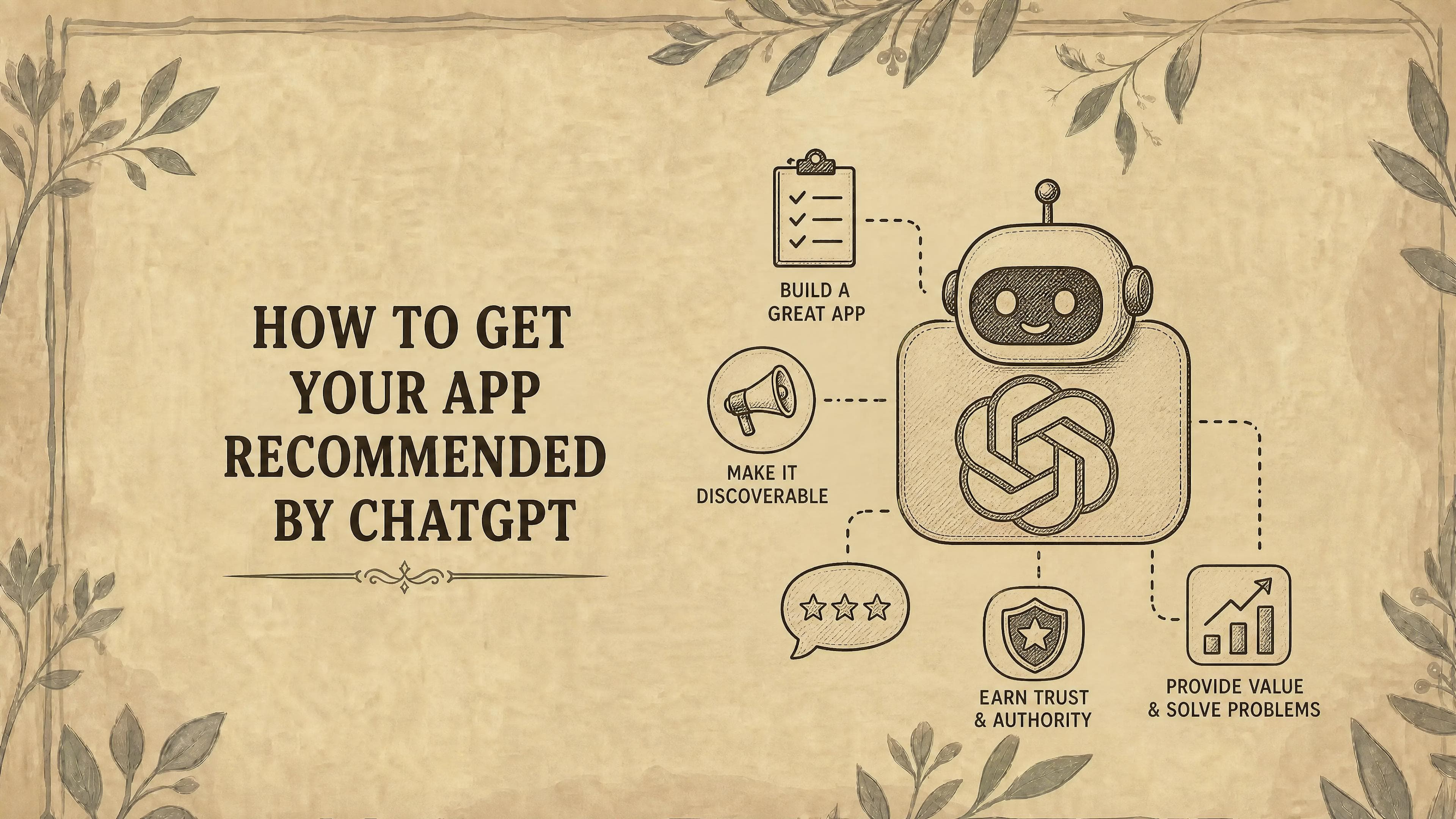
In short: ChatGPT recommends apps it can read about in many trustworthy places. To get your app recommended, describe clearly what it does and for whom on your own site, earn mentions in articles, reviews and comparisons that answer the questions your users ask, keep your App Store and Google Play pages precise, and post consistently on social platforms so your name keeps showing up. Then check regularly which prompts mention your app, and fix the gaps.
Getting your app recommended by ChatGPT has become part of app marketing. According to the Pew Research Center, 34% of US adults had used ChatGPT in 2025, about double the share in 2023, and 58% of adults under 30 had. When someone asks "what is the best app to track my budget" or "which app helps me learn Spanish", the assistant gives a short list of names. If your app is not on that list, the user may never search the App Store for alternatives.
How does ChatGPT decide which apps to recommend?
ChatGPT builds its answers from what it learned during training and, when it searches the web, from pages it finds and reads at that moment. An app gets recommended when the assistant has seen it described, again and again, as a good answer to that kind of question.
Three things weigh the most:
- Clarity: the assistant must understand what your app does, for whom, and how it differs. A vague homepage gives it nothing to quote.
- Mentions on other sites: articles, reviews, comparisons and forum threads that name your app in the context of a user need. The more often and the more consistently your app appears there, the stronger the signal.
- Freshness and accessibility: pages that can be crawled, read without logging in, and that were updated recently are easier to find when the assistant searches the web.
Google describes the same logic for its own AI features. Its page on AI features and your website explains that there is no special trick: content must be indexed, useful and easy to extract.
On ChatGPT's side, OpenAI documents the crawler its search uses, OAI-SearchBot, in its overview of OpenAI crawlers, and explains how answers cite web sources in its ChatGPT search help article. If your robots.txt blocks OAI-SearchBot, your pages cannot show up as sources in ChatGPT search.
What should your website say so ChatGPT understands your app?
Your website is the one source you fully control, so it should answer the questions an assistant needs to recommend you.
- One sentence that says what the app does and for whom, at the top of the homepage. For example: "a budget app for students that sorts expenses automatically".
- A page per main use case, written in the words your users would type into ChatGPT. Each page should describe the problem, how the app solves it, and who it suits best.
- A frequently asked questions section with real questions from support emails, reviews and social comments.
- Facts the assistant can quote: number of users if you publish it, platforms supported, price model, main features. Assistants prefer precise statements to marketing slogans.
Researchers at Princeton measured what makes content more likely to be cited by generative assistants. Their study on generative engine optimization found that adding sources, quotations and statistics can raise a page's visibility in generated answers by up to 40%. Precise, sourced pages are easier for an assistant to trust.
Why do mentions on other sites matter more than your own pages?
An assistant recommends what several independent sources agree on. Your own site says your app is great; ten articles that list it among the best apps in its category say the same thing with far more weight.
The mentions that count the most are the ones that match how users ask:
| Type of mention | Example of matching prompt | Why it helps |
|---|---|---|
| "Best apps for X" articles | "best app to plan meals" | The assistant often builds its list from these pages |
| Comparisons between apps | "is app A better than app B" | Places your app next to known names |
| Reviews and tests | "is this app worth it" | Gives the assistant arguments for and against |
| Forum and community threads | "what do people use to track habits" | Shows real users recommending you |
| Social videos and posts | "app to edit videos on my phone" | Keeps your name visible and associated with the use case |
A practical way to earn these mentions is to reach out to blogs that already rank for your category and propose something useful in exchange: a short description of your app, a free account to test it, or a link back to them from your own blog.
How do your App Store and Google Play pages influence AI answers?
Store pages are among the most read descriptions of any app, both by people and by tools that crawl the web. Apple explains in its guide to App Store search that search results depend on text relevance (title, subtitle, keywords and primary category) and on user behavior such as downloads, ratings and reviews.
Google gives the equivalent advice for Android in its Play Console help on creating your store listing and its store listing best practices: a clear app name, a short description that states the main use, and screenshots that show real features.
The same elements help an assistant:
- A title and subtitle that state the use case, not only the brand name.
- A first paragraph that answers "what does this app do" in one or two sentences.
- Recent reviews that mention specific benefits, because they read like independent testimonials.
- Consistent wording between the store page, your website and your social profiles, so every source describes the same app in the same way.
How does social content help an app get recommended?
Social content keeps your app's name in circulation and ties it to concrete uses. Short videos and slideshows that show the app solving one problem create a steady trail of public posts, captions and comments that mention it.
The hard part is consistency. Posting every day on TikTok, Instagram and other platforms takes hours that most app founders do not have. That is the job Genviral was built for: its agent, Vira, studies what works for apps like yours, creates slideshows and user-style videos, and posts them across platforms every day. Our AI content studio and TikTok scheduler cover the creation and the publishing.
Social posts alone will not make ChatGPT recommend you, but they feed the other two levers: people discover the app, write about it, review it, and those mentions are what assistants read.
How can you check whether ChatGPT recommends your app?
You cannot improve what you do not measure. The simplest method is to write a list of 20 to 30 prompts your users would ask, such as "best app for X" or "app to do Y on iPhone", and ask them to ChatGPT every month. Note whether your app appears, in which position, and which competitors are named instead.
Doing this by hand works for a few prompts but becomes slow as the list grows, and answers change from one week to the next. A tool can run the prompts for you and show the trend over time: you can track your visibility in ChatGPT with Sorank, which checks whether ChatGPT, Claude and Gemini mention your brand.
Each prompt where a competitor appears and you do not points to a gap: a use case your website does not describe, a "best apps" article where you are missing, or a comparison nobody has written yet.
What is a simple monthly routine to get recommended?
A routine beats a one-time push, because assistants keep reading new content.
- Check your prompts: run your list and note where you appear.
- Fix one page: add or improve the page for the use case where you are missing.
- Earn two mentions: contact two sites that rank for your category and propose a useful exchange.
- Refresh your store page: update the description and answer recent reviews.
- Keep posting: publish social content every day so your name stays tied to your use cases.
The bottom line
ChatGPT recommends the apps it reads about clearly and often, in trustworthy places. Describe your app precisely on your site, earn mentions in the articles and comparisons your users read, keep your store pages consistent, and stay visible on social platforms. Then measure which prompts mention you and close the gaps one by one. If daily social content is the part you never have time for, Genviral can take it off your plate.
Sources
- Pew Research Center, use of ChatGPT among US adults: 34% of US adults and 58% of adults under 30 had used ChatGPT in 2025.
- Princeton University and partners, "GEO: Generative Engine Optimization": what makes content more visible in generated answers.
- Google Search Central, AI features and your website: how Google's AI features use web content.
- Google Search Central, creating helpful, reliable, people-first content: what makes a page useful and trustworthy.
- Apple Developer, App Store search: the factors behind App Store search results.
- OpenAI, overview of OpenAI crawlers: how OAI-SearchBot and other OpenAI crawlers access websites.
- OpenAI Help Center, ChatGPT search: how ChatGPT searches the web and cites sources.
- Google Play Console Help, create your store listing: the fields and assets of a Google Play listing.
- Android Developers, store listing best practices: how to write a Google Play listing that converts.
Frequently asked questions
Can you pay to be recommended by ChatGPT?
Not in the answer itself. ChatGPT shows ads in some markets, but they are labeled and kept separate from its answers. The apps it names in an answer are the ones it has read clear, consistent descriptions and independent mentions of.
How long does it take for ChatGPT to start recommending an app?
It depends on how many mentions already exist and whether the assistant searches the web for the question. New pages can be picked up within weeks when ChatGPT searches the web, while mentions that shape its training take longer. Most apps see progress over a few months of steady work.
Does ChatGPT read App Store reviews?
ChatGPT can read public web pages when it searches, and store pages are public. Reviews that describe specific benefits help, because they read like independent opinions. Consistent wording between your store page and your website makes the picture clearer.
Is getting recommended by ChatGPT different from ranking on Google?
They overlap a lot. Both reward clear, useful, crawlable pages and mentions on trustworthy sites. The difference is that an assistant gives a short list of names instead of ten links, so being among the most cited options matters even more.
Which prompts should an app track?
Track the questions a new user would ask before downloading an app like yours: "best app for X", "app to do Y", and comparisons with the apps you compete with. Add the words your users write in reviews and support emails, since those are the words they also use with assistants.

Viktor
Occasional writer, sometimes even funny. Also loves to start conmpanies (weird, I know).